Choosing between automatic and manual cars in Tanzania depends on where and how you drive. Here’s the bottom line:
- City Driving (e.g., Dar es Salaam): Automatics are better for stop-and-go traffic, reducing fatigue and stress. They’re also more fuel-efficient in urban environments due to advanced technology.
- Rural or Off-Road Driving: Manuals provide better control on rough terrain, steep inclines, and unpaved roads. They’re also cheaper to maintain and repair, especially in areas with limited access to specialized mechanics.
- Cost Considerations: Manuals are generally more affordable upfront and have lower maintenance costs. Automatics are pricier but offer convenience and comfort.
Quick Comparison
| Criteria | Manual Transmission | Automatic Transmission |
|---|---|---|
| Initial Cost | Lower | Higher |
| Fuel Efficiency (City) | Lower | Higher |
| Fuel Efficiency (Highway) | Higher | Comparable |
| Maintenance Cost | Lower | Higher |
| Ease of Driving | Challenging in traffic | Easier in traffic |
| Terrain Handling | Better for rough roads | Less control on tough terrain |
Your choice should align with your driving habits, budget, and the type of roads you frequent. Automatics are gaining popularity in Tanzania, but manuals still dominate in rural areas for their reliability and lower costs.
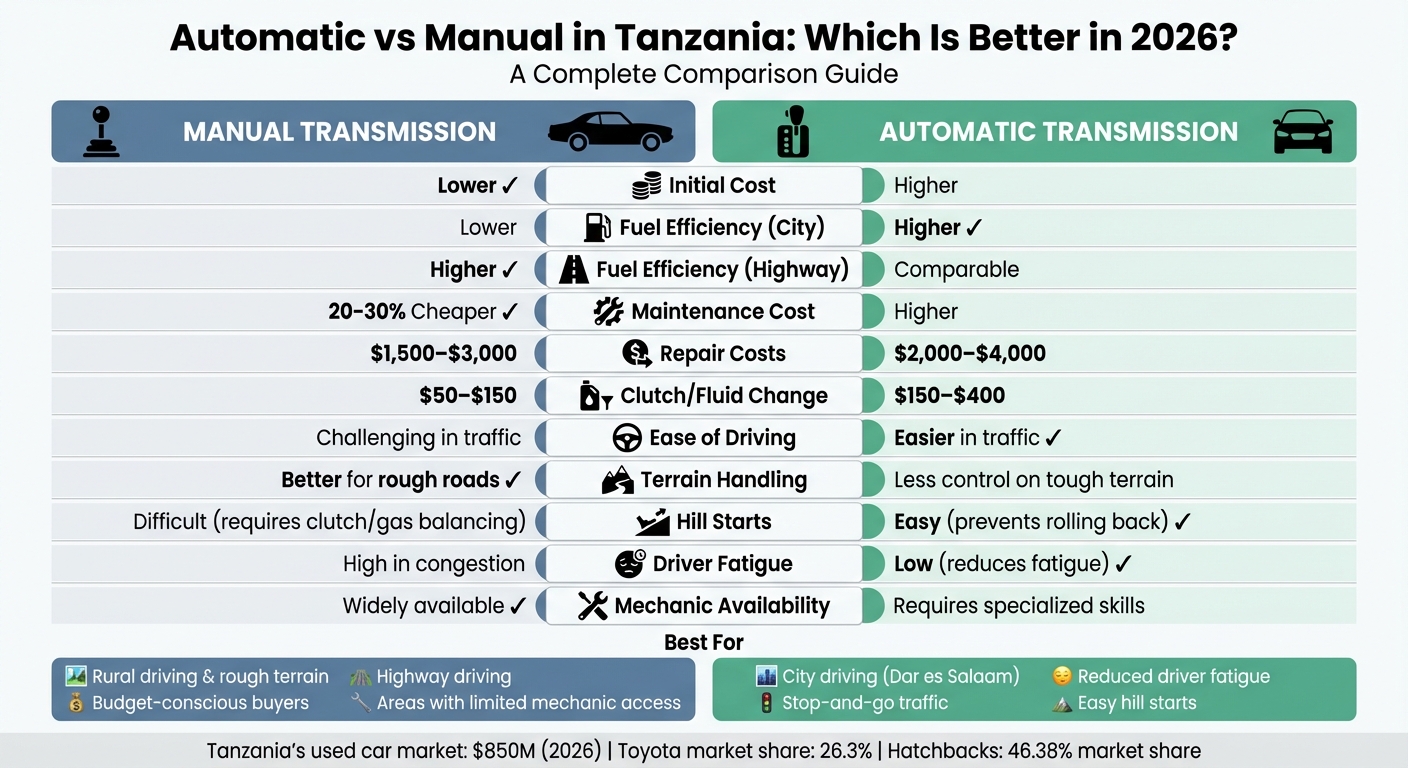
Automatic vs Manual Transmission Comparison for Tanzania 2026
Tanzania’s Car Market in 2026
Road Quality in Cities and Rural Areas
TANROADS oversees 37,435 km of roads, split between 12,527 km of trunk roads and 23,939 km of regional roads. Driving conditions in Tanzania can vary dramatically depending on whether you’re in a bustling city or a remote rural area.
In Dar es Salaam, drivers face heavy congestion and frequent stop-and-go traffic. This makes automatic transmissions a practical choice, as they help reduce driver fatigue and eliminate the hassle of constant clutch use. However, seasonal flooding in the city adds another layer of complexity, favoring vehicles with higher ground clearance and strong water seals.
When it comes to rural areas – like Arusha, Mwanza, or Dodoma – the story changes. Gravel roads, unpaved paths, and potholes that appear after the rainy season are common challenges. Vehicles with 170–200 mm (6.7–7.9 inches) of ground clearance are a must. Manual transmissions often perform better in these conditions, giving drivers more control over gear shifts to handle tough terrain and steep inclines.
"Those seasonal potholes and unpaved spurs demand at least 170–200 mm of clearance, and it’s always smart to check the bushings, shocks, and CV boots before sealing the deal", says Arif Hasnat, Car Specialist & Data Analyst at Carbarn.
These varying road conditions heavily influence car-buying decisions and shape the trends in Tanzania’s automotive market.
Market Availability and Buyer Preferences
Tanzania’s unique driving conditions significantly impact consumer preferences in the car market. Japanese used vehicles dominate the market, appreciated for their reliability and the easy availability of spare parts. By 2026, the used car market is projected to reach an estimated $850 million, with Toyota holding a commanding 26.3% market share.
Buyer preferences also reveal a clear urban-rural divide. In cities like Dar es Salaam, compact crossovers and hybrids – such as the Toyota Aqua, Honda Fit Hybrid, and Toyota Prius – are popular due to their fuel efficiency and suitability for urban conditions. On the other hand, rural buyers lean toward rugged models like the Toyota Hilux and Land Cruiser Prado, which can handle rough and uneven terrain.
Hatchbacks accounted for a 46.38% market share in 2025, but SUVs are quickly gaining ground. This segment is expected to grow at an annual rate of 10.6% through 2031. Budget cars, priced under $5,000, dominate sales, making up 43.88% of purchases in 2025. These are typically small Japanese "Kei" cars with engines ranging from 660 to 1,000 cc. Meanwhile, the premium segment ($20,000–29,999) is expanding at a rate of 10.7% annually, driven by aspirational buyers upgrading to SUVs and hybrids.
Import taxes play a significant role in car pricing. Vehicles are subject to a 25% import duty, 18% VAT, and a 2% Railway Development Levy, along with excise duties ranging from 0% to 10% depending on engine size. Additional excise duties on cars older than 8 years further push buyers toward newer models.
sbb-itb-d9186c2
Automatic vs Manual: Direct Comparison
Fuel Consumption and Running Costs
Modern automatic transmissions use advanced sensors to optimize gear shifts, achieving fuel efficiency that often rivals manual transmissions. This is particularly true in stop-and-go traffic, like in Dar es Salaam, where frequent gear changes in manuals can lead to wasted fuel.
Manual transmissions, however, excel on highways, where steady speeds and precise gear control can maximize efficiency. That said, the gap between the two is narrowing thanks to technological advancements. When it comes to initial costs, manuals still have the edge due to their simpler design. However, their resale value is declining as fewer people are comfortable driving stick shifts.
| Factor | Manual Transmission | Automatic Transmission |
|---|---|---|
| Initial Purchase Price | Lower | Higher |
| Fuel Efficiency (City) | Lower (frequent shifting/stalling) | Higher (optimized by sensors) |
| Fuel Efficiency (Highway) | High (driver-controlled) | Comparable to manual |
| Repair Costs | $1,500–$3,000 | $2,000–$4,000 |
These considerations set the stage for a closer look at how maintenance demands differ between the two transmission types.
Maintenance Costs and Repair Access
Long-term costs can vary significantly between manual and automatic transmissions. Manuals are typically 20% to 30% cheaper to maintain. Their simpler mechanical design means fewer parts that can fail, and repairs are generally less expensive. For example, clutch replacements, a common repair for manuals, cost between $500 and $1,500 (approximately 1.4M–4.2M TZS) and can be handled by most mechanics in Tanzania.
"Virtually any mechanic who has done one clutch can do any of them, and the [manual] transmissions are the easiest type to repair", says John Decker, Former City Carrier and Automotive Author.
Automatics, on the other hand, require specialized technicians and diagnostic tools. Their reliance on hydraulic fluid, sensors, and electronic components increases both routine maintenance and repair costs. For instance, a transmission rebuild or replacement for an automatic can range from $2,000 to $5,000+ (approximately 5.6M–14M TZS). Even routine fluid changes are pricier, costing $150–$400 every 60,000 to 100,000 miles, compared to $50–$150 for manuals.
| Feature | Manual Transmission | Automatic Transmission |
|---|---|---|
| Maintenance Cost | Lower (20-30% cheaper) | Higher due to complexity |
| Repair Complexity | Simple; fewer electronic parts | High; requires sensors/software |
| Fluid Change Cost | $50–$150 | $150–$400 |
| Common Failure Points | Clutch assembly | Solenoids, sensors, torque converters |
| Mechanic Availability | Widely available | Requires specialized skills |
For drivers in rural areas or outside major cities, where access to specialized mechanics is limited, manual transmissions remain the more practical option.
Driving Comfort and Road Performance
Automatic transmissions shine in urban environments, like the busy streets of Dar es Salaam. They eliminate the need for constant clutch work, reducing driver fatigue and making stop-and-go traffic much easier to handle. Automatics also simplify hill starts, preventing vehicles from rolling backward on steep inclines.
"Automatic transmission types simplify driving in congested traffic conditions, requiring little pedal inputs for stop-and-go situations", notes Cartrack Tanzania.
On the other hand, manual transmissions offer greater control, which is particularly useful on rural roads or challenging terrains. Drivers can hold specific gears to navigate potholes, gravel paths, or steep inclines more effectively. However, this level of control comes with added physical effort, making manuals less ideal for heavy traffic or hilly areas.
| Feature | Manual Transmission | Automatic Transmission |
|---|---|---|
| Hill Starts | Difficult; requires clutch/gas balancing | Easy; prevents rolling back |
| Terrain Control | High; driver chooses exact gear | Lower; computer selects gear |
| Driver Fatigue | High in congested areas | Low; eases driver fatigue |
Additionally, automatics promote safer driving by allowing drivers to keep both hands on the wheel at all times. Modern dual-clutch systems have also improved performance, offering smoother acceleration that rivals the traditional manual feel.
Which Transmission Fits Your Driving Style
For City Drivers
If you often find yourself navigating the bustling streets of Dar es Salaam, an automatic transmission could be your best friend. It’s perfect for stop-and-go traffic, offering smooth acceleration and sparing you the hassle of constant clutch work. This not only reduces driver fatigue but also makes the entire driving experience less stressful.
"Automatic transmissions eliminate clutch fatigue, reduce driver stress in traffic, and improve focus on the road", says Garware Hi-Tech Films.
For those focused on fuel efficiency, hybrids like the Toyota Prius shine in urban settings, delivering excellent mileage. Alternatively, Automated Manual Transmissions (AMTs) provide a budget-friendly option, though they can feel slightly jerky during shifts. While automatics dominate city driving, rural and highway conditions call for a different setup.
For Rural and Highway Drivers
When it comes to rural roads in Tanzania, where mud, steep inclines, and unpaved trails are common, manual transmissions take the lead. They give you full control over gear changes, making it easier to handle challenging terrain. Plus, engine braking on descents and precise power distribution are invaluable for navigating hilly or rough landscapes.
Manuals also come with the added benefit of lower repair costs compared to automatics. However, if you frequently tackle steep hills, automatics can be a lifesaver by preventing backward rolling during hill starts.
For Budget and Eco-Conscious Drivers
Your choice of transmission isn’t just about performance – it’s also about cost and environmental impact. Manuals are generally cheaper to buy and maintain thanks to their simpler mechanics. On the other hand, hybrids offer excellent fuel efficiency in city driving, though their higher upfront cost might give some buyers pause. AMTs strike a balance, offering the convenience of an automatic with the efficiency of a manual.
Additionally, recent policy changes in Tanzania have introduced excise duty exemptions for electric vehicles, making cleaner options more appealing and accessible. Keep in mind, though, that traditional automatics can add anywhere from $500 to $1,800 to the vehicle’s purchase price.
Making Your Decision in 2026
Choosing the right transmission depends on your driving habits and environment. If you’re frequently stuck in Dar es Salaam’s heavy traffic, an automatic transmission can save you from the hassle of constant clutch use, reducing fatigue during those long commutes. On the other hand, if your journeys often involve rural roads, steep inclines, or unpaved paths, a manual transmission will give you the control you need to handle those tougher conditions. This guide is here to help you weigh these factors as you plan for 2026.
Your budget and driving conditions play a major role in the decision. Manual cars generally cost less upfront and are easier (and cheaper) to repair. This makes them a solid choice for anyone keeping a close eye on total ownership costs, including insurance, registration fees, and long-term maintenance expenses.
"With the rising fuel and maintenance costs, opting for automatic transmission makes a lot of practical sense for fleet owners", says Cartrack Tanzania.
Before making a final decision, take the car for a thorough test drive. Pay attention to any unusual sounds, watch for vibrations, and go over the vehicle’s service history carefully. If you’re looking for a middle-ground option that combines efficiency with ease of use, an AMT (Automated Manual Transmission) might be worth considering.
These considerations reflect the changing dynamics of Tanzania’s car market. Automatic vehicles are becoming increasingly popular across the region, a trend that could shape the country’s automotive landscape in the coming years.
FAQs
What makes automatic cars a better choice for city driving in Tanzania?
Automatic cars are an excellent choice for navigating the bustling city traffic in Tanzania, thanks to their simplicity and comfort. Unlike manual transmissions, they eliminate the hassle of using a clutch or constantly shifting gears, which can be a real relief during stop-and-go traffic. This ease of operation helps reduce driver fatigue, making them perfect for daily commutes in crowded urban areas.
Another advantage is their efficiency in city driving. Modern automatic transmissions are designed to optimize gear shifts, which can save fuel during frequent stops and starts. On top of that, many automatic cars are equipped with advanced safety features like adaptive cruise control and lane-keeping assistance. These technologies add an extra layer of safety, especially in congested traffic conditions. With these benefits, automatic cars stand out as a convenient and practical option for urban driving in 2026.
Why are manual cars often a better choice for rural areas in Tanzania?
Manual cars are often preferred in rural areas of Tanzania because of their straightforward mechanics, which make them cheaper to buy and easier to fix. Their design is well-suited for the rugged, unpaved roads commonly found in these regions, offering drivers better control and a smoother ride in tough conditions.
Another advantage is their fuel efficiency, particularly in these challenging terrains. Given the limited availability of skilled mechanics and specialized tools in rural areas, the simple design of manual vehicles makes upkeep much more manageable and convenient.
How do import taxes impact car prices in Tanzania?
Import taxes play a huge role in determining the final price of vehicles in Tanzania, often adding 32% to 65% of the car’s declared value before registration. The Tanzania Revenue Authority (TRA) imposes a variety of taxes, including import duty, excise duty, VAT (18% on the mainland and 15% in Zanzibar), a railway development levy (2%), and fixed levies based on engine size. To discourage the import of older, high-pollution vehicles, additional surcharges are applied to such cars.
Here’s an example: importing a $10,000 used car with a 1,600 cc engine could result in taxes like $3,200–$4,500 in import and excise duties, $1,800 in VAT, $200 for the railway levy, and a fixed levy of $43. Altogether, the tax bill would range from $5,300 to $6,500, bringing the total cost of the car to $15,300–$16,500. For vehicles with larger engines or newer models, the taxes climb even higher, making import duties a major expense to consider when budgeting for a car purchase. Tanzanian buyers should be mindful that these taxes can increase the price of an imported car by anywhere from one-third to two-thirds of its original value.
Related Blog Posts
- Best used cars in Tanzania 2025
- Car prices in Dar es Salaam
- Diesel or Petrol: What’s best in Tanzania
- Automatic vs Manual Cars: What’s Best for Tanzanian Drivers?