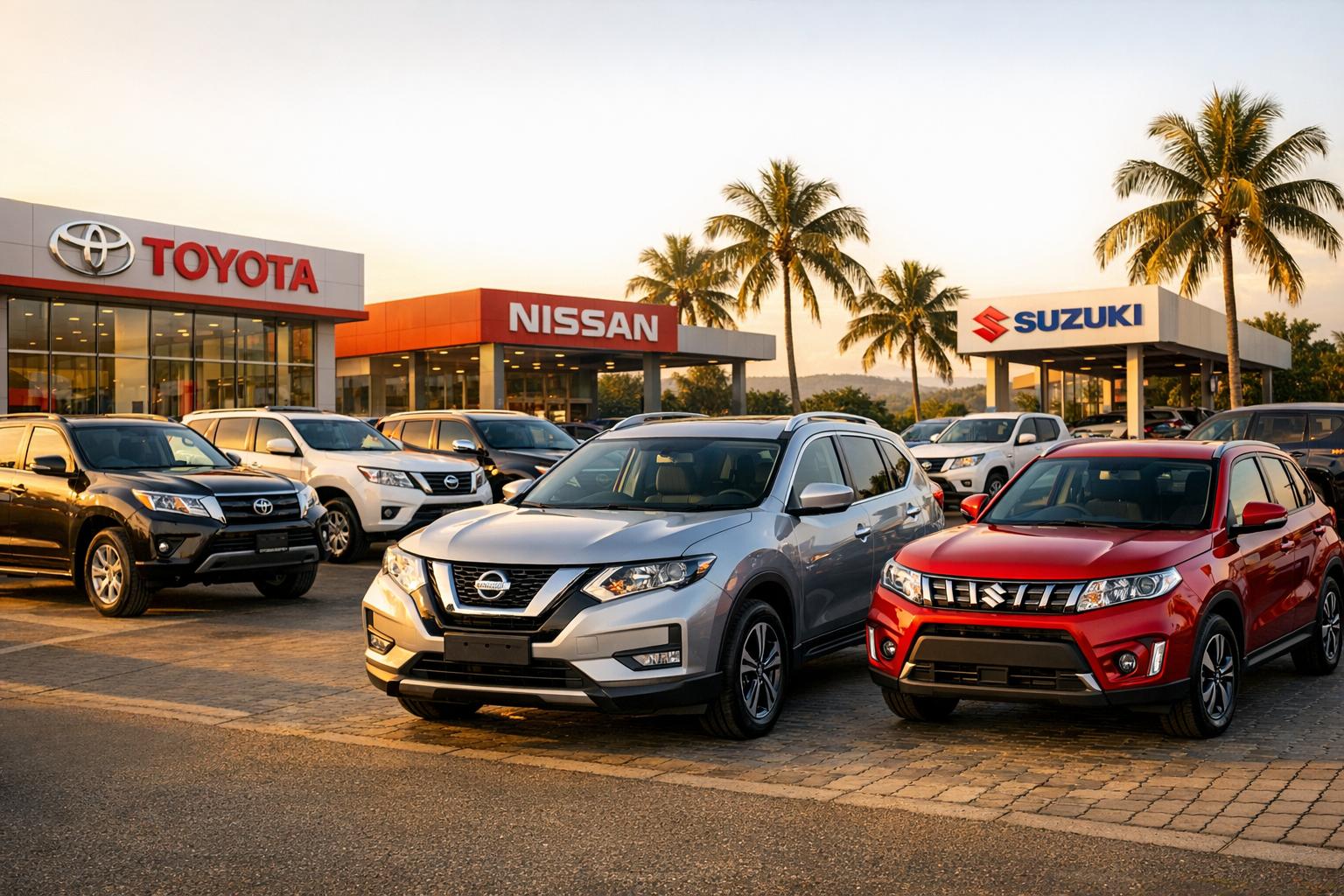
If you’re buying a car in Tanzania, reliability, cost, and access to spare parts matter most. Toyota, Nissan, Subaru, Suzuki, and Isuzu are the top brands for 2025, dominating the market with their durable builds, fuel-efficient engines, and strong resale value. Here’s a quick breakdown:
- Toyota: The market leader with unmatched durability, easy maintenance, and high resale value. Models like the Hilux and Land Cruiser excel on rugged terrain.
- Nissan: Affordable and reliable, with models like the Navara and Dualis offering solid performance for city and rural use.
- Subaru: Known for AWD vehicles like the Forester, great for handling tough roads, though maintenance can be pricier.
- Suzuki: Budget-friendly and fuel-efficient, ideal for urban driving. The Jimny and Escudo handle off-road needs well.
- Isuzu: Perfect for commercial use with tough models like the D-Max, reliable for heavy-duty tasks and rural roads.
Quick Comparison
| Brand | Durability | Spare Parts Availability | Fuel Economy | Resale Value |
|---|---|---|---|---|
| Toyota | High | Excellent | Good | Very High |
| Nissan | Good | Good | Moderate | Moderate |
| Subaru | High | Moderate | Moderate | Moderate |
| Suzuki | Moderate | Good | High | Moderate |
| Isuzu | Very High | Good | Moderate | High |
Whether you’re navigating city traffic, tackling rural roads, or managing a business fleet, these brands meet Tanzania’s diverse driving needs.

Top 5 Car Brands in Tanzania 2025: Durability, Parts, Fuel Economy & Resale Value Comparison
Before You Buy a Car in Tanzania – WATCH THIS! East Cars Exposes the Truth
1. Toyota
Toyota dominates the Tanzanian car market, claiming 7 out of the top 8 spots for popular vehicles. Its reputation for reliability and performance in challenging environments has made it a go-to choice for many drivers in the region.
Durability
Toyota is synonymous with durability in Tanzania. Models like the Hilux and Land Cruiser are built to handle everything from bumpy urban roads to rugged rural trails. Their robust engineering ensures long-lasting engines, with many owners reporting minimal major repairs even after 20 years of use. The Land Cruiser Prado and Hilux stand out as favorites for their off-road prowess, making them ideal for navigating Tanzania’s diverse terrain.
Spare Parts Availability
Toyota’s extensive network of service centers in Tanzania is a major plus. These centers are staffed with Toyota-trained technicians and stocked with genuine parts, ensuring maintenance is straightforward and affordable. Additionally, Toyota’s practice of using shared components across multiple models simplifies the process of finding replacement parts. Routine tasks, like replacing brake pads or filters, are also budget-friendly.
"At Toyota, we pride ourselves in only using genuine parts and Toyota-trained technicians at our state-of-the-art service centers across Tanzania." – Toyota Tanzania
Fuel Economy
Toyota offers a range of vehicles with impressive fuel efficiency. The Toyota Starlet boasts an urban fuel consumption rate of 5.4L/100km (44 mpg). Other models like the Urban Cruiser, Land Cruiser 79, and Hilux deliver 6.2L/100km (38 mpg), 8.0L/100km (29 mpg), and 8.5L/100km (28 mpg), respectively.
Resale Value
Toyota vehicles hold their value exceptionally well in Tanzania. High-demand models like the Land Cruiser Prado, Hilux, and RAV4 command strong resale prices. For example, a 2015 Toyota Premio typically sells for $5,940–$10,940, while a 2021 Toyota Harrier can fetch anywhere from $19,300 to $33,860. Toyota’s "Automark" certified pre-owned program further enhances resale value by offering warranties on used vehicles, giving buyers added peace of mind.
Next, let’s explore Nissan, another brand known for its reliability and affordability.
2. Nissan
Nissan has established itself as a trusted name in Tanzania, earning recognition for its rugged, reliable vehicles that are well-suited for both city streets and remote, challenging terrains. The brand promotes itself as a "preferred fleet partner", catering to diverse driving needs across the country.
Durability
Nissan’s "Built for Africa" lineup, which includes models like the Navara and NP300 Hardbody, is specifically designed to endure Tanzania’s demanding conditions [11, 14]. Every new Nissan sold in Tanzania is backed by a 3-year/100,000 km (about 62,000 miles) warranty and a service plan, ensuring peace of mind for buyers. A standout example is the Nissan Magnite, which boasts a 5-Star Overall Passenger Safety rating from GNCAP, achieving top marks for adult occupant protection.
"Designed to handle the toughest terrain, Nissan keeps going when others would give up." – Nissan Tanzania
Spare Parts Availability
Nissan supports its customers through a broad service network across Tanzania, offering genuine spare parts that come with a 12-month warranty. For added affordability, the brand also provides economical "Key Value" options for popular models.
Fuel Economy
Efficiency is another strong suit for Nissan. Take the Nissan Dualis, for example – it delivers an impressive 12.5 km/L (around 29 mpg) thanks to its advanced Xtronic CVT technology, making it a practical choice for urban driving [2, 15].
Resale Value
Nissan vehicles hold their value well in Tanzania’s resale market. For instance, the Nissan Dualis commands the following resale prices:
- 2010 models: $2,440 – $4,700
- 2012 models: $3,170 – $7,920
- 2013 models: $4,300 – $5,980
With their durability, fuel efficiency, and strong resale value, Nissan vehicles remain a reliable choice for drivers in Tanzania.
3. Subaru
Subaru stands out as one of the most dependable car brands, ranking #2 in new car reliability for 2025, right after Toyota. In Tanzania, Subaru has earned a strong reputation for handling rough terrain, thanks to its standard full-time all-wheel drive (AWD) system, which comes standard in most of its models. Let’s dive into what makes Subaru such a durable choice for Tanzanian roads.
Durability
Subaru’s signature horizontally opposed "boxer" engines are designed to minimize vibration and lower the vehicle’s center of gravity, which improves stability on uneven terrain. This makes Subaru vehicles particularly well-suited for the diverse and often challenging road conditions found in Tanzania, whether you’re navigating bustling city streets or venturing onto rugged rural paths. The brand’s commitment to reliability is also linked to its practical design philosophy – many components are shared across different models, which has been shown to improve long-term dependability.
"Subaru is known for no-nonsense SUVs with standard full-time all-wheel drive." – Consumer Reports
Spare Parts Availability
While Subaru vehicles are built to last, the availability of spare parts remains a critical factor. Maintenance and repair costs for Subaru rank #20 among major automakers. However, the brand’s smaller market share means that spare parts are often more specialized, which can result in longer wait times and higher costs for repairs.
Fuel Economy
One of Subaru’s standout models in Tanzania is the Forester, which features 1.5L to 2.0L engines that strike a balance between performance and efficiency for both city driving and off-road adventures. That said, the AWD system, while excellent for traction and stability, does consume more fuel, which can increase overall ownership costs. Additionally, the maintenance of the CVT (Continuously Variable Transmission) system adds to these expenses.
sbb-itb-d9186c2
4. Suzuki
After Subaru’s impressive offerings, Suzuki steps in as a more affordable yet reliable choice for drivers in Tanzania.
Suzuki caters to budget-conscious drivers who need a practical, fuel-efficient vehicle that performs well on both city roads and rugged rural paths. Its compact SUVs like the Escudo and smaller hatchbacks such as the Swift and Celerio are widely popular in Tanzania, thanks to their low running costs and straightforward mechanics.
Durability
Suzuki vehicles are known for their reliability, with minimal issues related to engines, transmissions, or brakes. The Suzuki Escudo, in particular, stands out for its off-road capabilities, making it a great match for Tanzania’s diverse landscapes. For those who venture into more challenging terrains, models like the Jimny offer high ground clearance and 4WD, ensuring a smooth journey even on unpaved roads. Regular upkeep is key to maintaining this level of dependability.
Spare Parts Availability
One of Suzuki’s biggest advantages in Tanzania is the easy access to affordable spare parts, especially for its compact models and imported Japanese Kei cars. CFAO Motors, the official distributor of Suzuki in Tanzania, ensures a steady flow of new vehicles and genuine parts. Spare parts are readily available in major cities like Dar es Salaam, Arusha, and Mwanza. This accessibility helps minimize repair delays and keeps maintenance costs in check, which is a critical factor for Tanzanian drivers.
Fuel Economy
Suzuki’s standout feature is its impressive fuel efficiency. The brand’s small to mid-sized engines are perfect for handling the stop-and-go traffic common in Tanzanian cities. For example, the Suzuki Escudo LY achieves 24 km/L with its 1.0-liter engine, while the 1.5-liter Hybrid delivers 22.5 km/L. Even older 1.3-liter models manage a respectable 17 km/L. With petrol prices averaging $1.10 per liter in mid-2025, these efficient engines help Tanzanian households stretch their budgets further, making Suzuki a practical choice for cost-conscious buyers.
Resale Value
Suzuki vehicles also hold their value well in Tanzania’s used car market. On platforms like GariPesa, used Suzuki prices typically start at TSh 6.5 million ($2,800) for hatchbacks like the Swift and go up to TSh 18 million ($7,700) for SUVs such as the Escudo or Jimny. Their combination of affordable purchase prices, reliable performance, and accessible spare parts ensures that Suzuki models sell quickly compared to many competitors. The average price for used Suzuki vehicles is around TSh 12.8 million ($5,500), making them a smart option for first-time buyers and anyone seeking dependable transportation.
5. Isuzu
Isuzu holds the spot as Tanzania’s second most popular automotive brand, following Toyota, as of early 2025. Known as a reliable "commercial workhorse", Isuzu has become a trusted choice for businesses and families alike, offering vehicles that handle both urban streets and rugged terrains with ease. This reputation is built on dependable engineering and consistent performance.
Durability
Isuzu vehicles are built to endure, and the D-Max pickup is a prime example, praised for its toughness on Tanzania’s challenging roads. Features like high ground clearance and a ladder-frame chassis give these vehicles the ability to perform reliably across a variety of terrains. Isuzu trucks are even trusted by the Tanzanian government for heavy-duty construction projects in demanding locations such as Ruaha National Park. This proven durability has contributed to a 14% sales growth in the first half of 2025, solidifying Isuzu as Toyota’s closest competitor.
Spare Parts Availability
One of Isuzu’s biggest strengths lies in its strong regional presence. With a 45% market share in East Africa and over 6,000 vehicles assembled annually in Kenya, genuine spare parts are easy to find in Tanzania. Because these vehicles are assembled regionally, duty-free exports from Kenya help keep costs in check. Wanjohi Kangangi, Director of Isuzu East Africa, highlights that local assembly makes the vehicles more accessible across the region. This setup ensures that Isuzu owners can maintain their vehicles without unnecessary hassle.
Fuel Economy
Isuzu’s advanced turbo-diesel engines strike a balance between performance and fuel efficiency. The 1.9-liter turbo diesel engine, featured in models like the MU-X, achieves an impressive 13.9 km/l (about 32.7 mpg), while the larger 3.0-liter Blue Power engine delivers between 11.0 and 12.5 km/l (25.9 to 29.4 mpg). These engines are designed to minimize running costs while providing high torque, making them suitable for both highway cruising and off-road adventures. For businesses managing fleets or families embarking on long trips, these fuel savings are a practical advantage.
Resale Value
Isuzu vehicles retain their value well in Tanzania, which further strengthens their market appeal. While 94% of vehicle sales in the country currently come from used imports, Isuzu’s locally assembled models present a strong alternative, offering better warranty coverage and easier access to parts. The D-Max and MU-X models are particularly popular in the used market, thanks to their durability and consistent demand. For buyers seeking a vehicle that performs well on varying road conditions while maintaining its worth over time, Isuzu is a smart choice.
Pros and Cons
Here’s a breakdown of the strengths and trade-offs for each of the five brands, highlighting what they bring to the table and where they may fall short.
Toyota is the go-to choice for durability and resale value. Popular models like the Premio, RAV4, and Hilux dominate the market, selling faster than their competitors. However, this reliability and reputation come with a higher price tag – not just for the vehicles but also for genuine parts.
Nissan offers a more budget-friendly option. Models like the X-Trail provide solid utility and ground clearance without breaking the bank. While parts are generally available, they don’t quite match Toyota’s widespread accessibility.
Subaru caters to driving enthusiasts, especially those who appreciate Symmetrical AWD for better handling during wet seasons. However, owning a Subaru demands regular upkeep, particularly for CVT transmissions and suspension systems.
Suzuki stands out for its fuel efficiency, making it a smart choice for urban drivers on a budget. The compact Jimny is surprisingly capable off-road. That said, Suzuki’s resale value is moderate compared to giants like Toyota or Isuzu.
Isuzu excels in the commercial sector, thanks to its reputation as a workhorse. The D-Max has gained traction for its durability. While its diesel engines prioritize torque over fuel efficiency, Isuzu holds strong resale value in the commercial market, though it lacks Toyota’s universal appeal.
For a quick comparison, here’s how the brands stack up:
| Brand | Durability | Spare Parts Availability | Fuel Economy | Resale Value |
|---|---|---|---|---|
| Toyota | Exceptional / "Unbreakable" | Excellent (Nationwide) | High (especially hybrids) | Very High |
| Nissan | Good / Reliable | Good | Moderate to High | Moderate |
| Subaru | High (requires care) | Moderate | Moderate | Moderate |
| Suzuki | High (off-road focus) | Good | High (small engines) | Moderate |
| Isuzu | Very High (workhorse) | Good | Moderate (diesel focus) | High (commercial) |
Toyota offers hassle-free ownership, Nissan balances cost and utility, Subaru excels in handling, Suzuki saves on fuel, and Isuzu delivers unmatched reliability for commercial use. These insights should help you pick the vehicle that fits your priorities.
Conclusion
After diving into detailed brand reviews, let’s tie it all together by matching your needs with the right manufacturer. When choosing a car, factors like durability, spare parts availability, fuel efficiency, and resale value should guide your decision.
Toyota continues to set the standard for reliability and easy access to parts. Nissan offers great value, Subaru stands out for dependable performance, and Suzuki excels with compact cars that prioritize fuel economy.
For city dwellers, fuel-efficient hatchbacks – like those from Toyota – are a smart choice. These cars deliver impressive mileage, often between 17 and 20 km per liter, and handle Dar es Salaam’s crowded streets with ease. Automotive journalist Josephat Lukaza sums it up perfectly:
"In urban areas, where roads are generally in good condition, most people prefer small, efficient cars that are easy to maneuver in busy city environments."
It’s no surprise that hatchbacks dominate 46.95% of the used car market share in 2024, making them a clear favorite for urban drivers.
For those navigating rural terrain, vehicles built for rugged conditions are a must. Models like the Toyota Land Cruiser and Hilux are celebrated for their toughness, while the Suzuki Escudo and Nissan Dualis provide strong ground clearance at more budget-friendly prices. Features like AWD or 4WD and high ground clearance are non-negotiable for reliable performance on unpaved roads.
Business users, on the other hand, benefit from robust after-sales support. Toyota leads the pack here with its extensive network of service centers and readily available genuine parts. The Toyota Hilux is a reliable workhorse for commercial transport, while models like the Noah and Hiace are versatile options for passenger and multi-purpose needs.
As the Tanzanian used car market grows – projected to hit $0.79 billion by 2025 – expanded financing options and digital platforms are making car purchases more transparent. Whether you’re navigating city streets, tackling rural challenges, or managing a business fleet, these trusted brands offer vehicles that meet the demands of Tanzania’s diverse driving conditions.
FAQs
Why is Toyota one of the most trusted car brands in Tanzania?
Toyota has earned a strong reputation in Tanzania thanks to its dependability, long-lasting performance, and ability to handle the country’s varied road conditions, including challenging terrains. These qualities make Toyota vehicles a trusted option for drivers looking for consistency and durability.
Another major advantage is Toyota’s high resale value, which appeals to many buyers. The brand also benefits from an extensive network of service centers and the easy availability of spare parts across Tanzania, making maintenance both simple and cost-effective. These factors, paired with Toyota’s well-established reputation for quality, have cemented its status as a favorite among Tanzanian car buyers.
Why are Isuzu vehicles a reliable choice for commercial use in Tanzania?
Isuzu vehicles have earned a strong reputation in Tanzania for their toughness and reliability, especially on challenging roads. Built with sturdy chassis and designed to carry heavy loads, they’re a go-to choice for industries such as construction, mining, and logistics. With fuel-efficient diesel engines, these vehicles deliver the power needed for transporting heavy goods over long distances, making them a smart pick for commercial use.
What’s more, Isuzu’s commitment to local assembly in East Africa helps keep costs down and speeds up delivery times. Customers also enjoy the convenience of readily available spare parts and dependable after-sales support through authorized dealers. These advantages make Isuzu a trusted partner for businesses throughout Tanzania.
Why is spare parts availability important for car maintenance in Tanzania?
Spare parts availability is a key factor in car maintenance across Tanzania, as it directly impacts how efficiently and affordably vehicles can be repaired. When parts for popular brands like Toyota and Suzuki are readily available locally, both routine maintenance and emergency repairs can be handled swiftly. This minimizes downtime and keeps repair costs under control.
Brands with strong distribution networks in Tanzania hold a clear advantage. Their parts – like brake pads, oil filters, and timing belts – are often stocked at local dealerships and service centers, ensuring faster access when needed. In contrast, cars with limited spare parts availability may require sourcing components from abroad, which not only increases wait times but also raises costs. Reliable access to spare parts not only keeps vehicles running smoothly but also reduces the overall cost of ownership and reinforces confidence in the brand’s reliability.