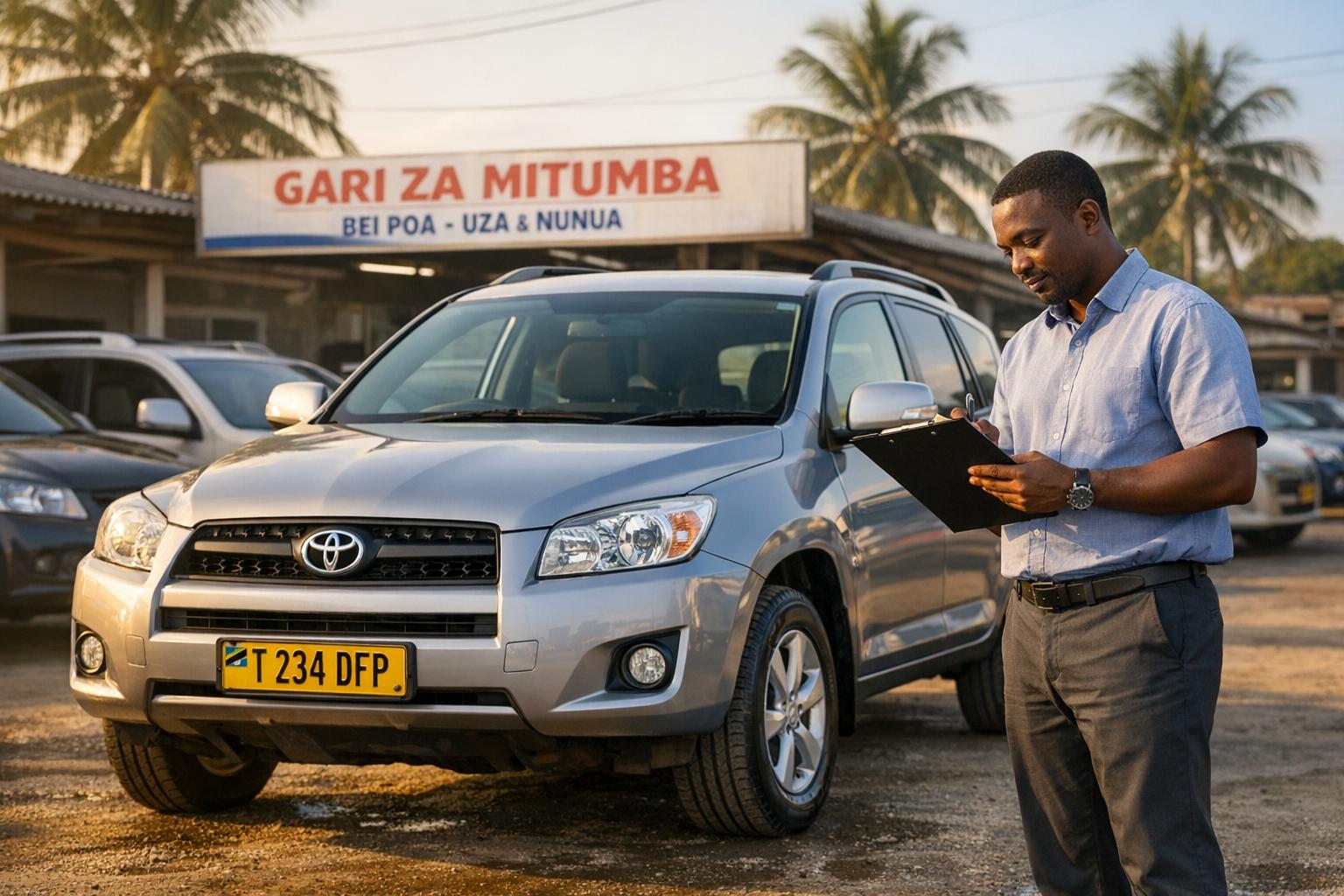
If you’re buying a used car in Tanzania, you need to be cautious. Scammers are targeting buyers with fake listings, tampered documents, and shady practices. Here’s a quick checklist to protect yourself:
- Verify the Seller: Confirm their identity and registration with the Tanzania Revenue Authority (TRA) or Japan Used Motor Vehicle Exporters Association (JUMVEA) for imports. Insist on a video call to confirm the car exists.
- Inspect Documents: Check the original logbook, tax clearance, auction sheets (for imports), and ensure all details match. Use TRA and TBS portals to verify records.
- Be Wary of Prices: Compare the asking price with TRA’s valuation. Suspiciously low prices often hide issues like unpaid fines or legal problems.
- Inspect the Car: Bring a mechanic to check for odometer tampering, engine issues, and hidden damage. Test drive the car and run diagnostics.
- Confirm Legal Status: Verify ownership, liens, and theft reports using TRA and police systems. Ensure import duties and taxes are fully paid.
- Avoid Common Scams: Be cautious of fake online ads, mileage tampering, and sellers who rush payments or avoid in-person meetings.
Pro Tip: Always finalize the purchase with a signed sales agreement and complete ownership transfer through TRA to avoid future disputes. Following these steps can help you avoid scams and make a safe purchase.

6-Step Used Car Scam Prevention Checklist for Tanzania Buyers
Before You Buy a Car in Tanzania – WATCH THIS! East Cars Exposes the Truth
Step 1: Check the Seller’s Background
Before making a purchase, take the time to verify the seller’s identity. Scammers often use fake identities or pretend to be legitimate businesses to trick buyers. Reports confirm that fraudulent online advertisements are a common issue.
Look Into the Seller’s History
The first step in protecting yourself from scams is to confirm the seller’s credentials. If you’re dealing with a seller importing vehicles from Japan, check whether they’re registered with the Japan Used Motor Vehicle Exporters Association (JUMVEA). This organization, recognized by the government, operates a "Safe Trade" system to ensure fair practices.
For sellers claiming to be dealerships in Tanzania, verify their registration with the Tanzania Revenue Authority (TRA). You can do this easily by visiting the official TRA website at tra.go.tz.
For quick verification, dial _152_00# on your phone and select TRA Services. You can also use this code to confirm insurance details through TIRA.
Be cautious of sellers who won’t provide their full name, registration number, or address – this is often a red flag.
Insist on a Video Call
Never send money without first confirming that the vehicle is real. Request a live video call where the seller shows you the car’s engine bay, interior, and chassis number plate to prove its existence.
During the call, ask the seller to start the car while it’s cold and show you the exhaust. Look out for heavy or colored smoke, as this could indicate engine problems. You should also ask for a clear view of the Vehicle Identification Number (VIN) or chassis number on the vehicle’s frame. This will allow you to cross-check it with the logbook later.
If the seller refuses to participate in a video call, consider it a major warning sign and walk away immediately.
Step 2: Review Vehicle Documents
Once you’ve confirmed the seller is legitimate, the next step is to carefully review the vehicle’s documents to ensure a safe and legal purchase.
Pay close attention to every document to avoid falling victim to forgeries or discrepancies.
Check Auction Sheets for Imports
If the vehicle is imported from Japan, ask for the original auction sheet. This sheet details the car’s condition, mileage, and any recorded damages. Cross-check the mileage on the auction sheet with the odometer reading – any mismatch could indicate tampering.
Since July 20, 2022, all used vehicles imported from Japan must come with a Pre-shipment Verification of Conformity (PVoC) certificate before entering Tanzania. Request this certificate from the seller and verify it through the Tanzania Bureau of Standards (TBS). Without it, the vehicle won’t be legally allowed into the country.
Confirm Ownership Papers
The original logbook is your proof of legal ownership.
"The logbook is a legal document proving ownership. Without it, the transfer cannot be completed legally".
Always insist on seeing the original logbook – photocopies are not acceptable for final verification. Double-check that the VIN (Vehicle Identification Number) stamped on the car matches the one listed in the logbook.
Use the TRA UMVVS portal at gateway.tra.go.tz/umvvs to verify the car’s tax value and check for any unpaid fines or legal issues by entering the registration plate on the TMS system.
Additionally, ask for the Tax Clearance Certificate to confirm all import duties have been settled with the TRA. Make sure the seller also provides a valid Vehicle Inspection Certificate to prove the car has passed roadworthiness tests.
Key Documents and Their Verification
| Document Type | Purpose | Verification Method |
|---|---|---|
| Original Logbook | Proves legal ownership | Cross-check with the TRA portal |
| PVoC Certificate | Confirms import standards (Japan) | Verify through TBS (Tanzania Bureau of Standards) |
| TMS Report | Checks for unpaid traffic fines | Search plate number at tms.tpf.go.tz |
| Inspection Certificate | Confirms roadworthiness | Check the validity date and issuing center |
| Sales Agreement | Proof of transaction | Must be signed by buyer, seller, and witness |
Taking these steps ensures the vehicle’s documents are in order, helping you avoid potential legal or financial issues down the line.
Step 3: Watch for Pricing and Payment Warnings
After verifying the documents, the next step is to carefully examine the pricing and payment methods. Scammers often lure buyers with tempting prices or push risky payment options to rush decisions, leading to costly mistakes.
Question Unusually Low Prices
If the price seems too good to be true, it probably is. Check the TRA UMVVS portal at gateway.tra.go.tz/umvvs to compare the asking price with the Current Retail Selling Price (CRSP). Be especially cautious of sellers who pressure you with urgent offers, as this tactic is often used to bypass your due diligence. A suspiciously low price could also mean you’re inheriting hidden issues like unpaid traffic fines or legal complications.
If the seller’s price is significantly lower than the TRA’s valuation, it may indicate under-invoicing – a practice closely monitored by the TRA. Keep in mind that the TRA calculates taxes based on its UMVVS valuation, not the seller’s discounted price. So, a lower purchase price won’t save you on taxes.
Once you’ve confirmed the price is reasonable, shift your focus to selecting a secure payment method.
Choose Safe Payment Options
Never send payment before inspecting the vehicle and verifying the seller’s credibility. Cash payments should be avoided since they leave no audit trail.
For secure transactions, opt for bank transfers, mobile money services like M-Pesa or Airtel Money, or escrow services for higher-value purchases. Always ensure you receive a legal sales agreement and a fiscal receipt once payment is completed. Escrow services are particularly useful for large transactions, as funds are only released once all conditions are met and documents are verified. Finally, confirm that the funds have officially cleared – don’t rely on SMS notifications alone, as these can be falsified.
| Payment Method | Security Level | Best Use Case |
|---|---|---|
| Bank Transfer | High | Large transactions requiring official records |
| Mobile Money (M-Pesa/Airtel Money) | Medium-High | Convenient for deposits after in-person inspection |
| Escrow Services | High | High-value purchases to protect both parties |
| Cash | Low | Not recommended – no paper trail or legal protection |
Step 4: Inspect the Vehicle in Person
After securing a safe payment method, the next step is a hands-on inspection of the vehicle. While paperwork might look perfect, it won’t reveal hidden mechanical issues. Seeing the car in person is the only way to uncover problems that photos or documents can’t show.
Bring a Qualified Mechanic
It’s smart to bring along a qualified mechanic for this step. They can check for odometer tampering, assess the condition of the engine, transmission, and suspension, and ensure the chassis and engine numbers match the registration. A seasoned mechanic can often detect odometer manipulation by comparing the mileage with the car’s overall wear and tear. Additionally, they’ll confirm that the chassis and engine numbers physically stamped on the vehicle align with the registration card. Mismatched numbers can be a red flag for stolen or illegally registered cars.
Don’t overlook the underside of the car – dark spots or puddles could point to fluid leaks. Watch the exhaust during startup for smoke, and test every electronic feature, from the air conditioning to power windows and dashboard controls. Also, check tms.tpf.go.tz to ensure there are no outstanding fines tied to the vehicle. Any unpaid fines will become your responsibility once you own the car.
Once your mechanic has completed their inspection, it’s time to take the car for a test drive to get a feel for its performance.
Test Drive and Run Diagnostics
A test drive is essential to spot unusual noises, vibrations, or handling issues. During the drive, use a diagnostic scanner to uncover hidden error codes that might indicate problems the seller hasn’t disclosed. Listen carefully for any strange sounds, such as those signaling transmission or suspension trouble. Pay attention to how the car drives – vibrations, pulling to one side, or difficulty shifting gears can all signal major issues.
Watch for signs of flood damage, too. Check seatbelt ends for water stains, mold, or dirt. Lift the trunk carpet and remove the spare tire to inspect for standing water, silt, or rust in the spare tire well. Examine the engine oil; if it looks milky or has a "milkshake" consistency, it’s a sign of water contamination. As Roger Morris, former Communications Officer at the National Insurance Crime Bureau, cautions:
"Consumers should be very cautious of any used vehicle they buy in the aftermath of a flood. You can clean up a car pretty well, but it’s the two to three months afterward when problems really start to show up".
Here’s a quick guide to common flood damage indicators:
| Area to Inspect | Specific Red Flags | Likely Cause |
|---|---|---|
| Engine Oil | Milky, frothy, or "milkshake" appearance | Water contamination/Flood |
| Interior | Musty smell, damp carpets, rust on seat bolts | Flood or major leak |
| Lights | Fog, water droplets, or silt inside lenses | Submergence in water |
| Electronics | Flickering dash lights, slow power windows | Corroded wiring/Flood |
| Engine Bay | Dried mud in starter motor or power steering pump recesses | Deep water exposure |
sbb-itb-d9186c2
Step 5: Verify Import and Ownership Records
After confirming the vehicle is mechanically sound, the next step is to ensure its legal status is in order. Even a car in great condition can lead to financial headaches if it has unresolved ownership disputes, unpaid liens, or fraudulent import documents. Tanzania has strict import regulations, and vehicles improperly cleared through customs risk being seized or subjected to hefty fines.
This step builds on your mechanical inspection by focusing on verifying the vehicle’s legal and import records to avoid potential liabilities.
Review Import Papers
For imported vehicles, it’s essential to confirm that the car entered Tanzania through legal channels. Since July 20, 2022, all used cars imported from Japan must undergo Pre-shipment Verification of Conformity (PVoC) before shipping. This process ensures the vehicle meets Tanzania’s standards and results in a Certificate of Conformity (CoC) issued by the Tanzania Bureau of Standards (TBS). Without this document, the vehicle may be rejected at the port or incur significant fines.
To verify the CoC, visit the TBS Online Application System at oas.tbs.go.tz. Additionally, request key documents from the seller, such as the Final Invoice, Bill of Lading, Packing List, and TBS Import Permit. Legitimate imports are recorded in TANCIS by a Licensed Clearing and Forwarding Agent (CFA) at least seven days before the vessel arrives.
Use the TRA Used Motor Vehicle Valuation System at umvvs.tra.go.tz to cross-check the CRSP (Current Retail Selling Price) and confirm that all import duties and VAT have been paid. Missing or mismatched paperwork could indicate smuggling or tax evasion, which could lead to serious legal trouble.
Once you’ve confirmed the import documents are in order, shift your focus to the vehicle’s ownership history.
Check for Liens or Theft Reports
Visit a Tanzania Revenue Authority (TRA) office to confirm there are no liens or caveats on the vehicle’s logbook, as these are often placed by banks or microfinance institutions. It’s equally important to ensure the car isn’t flagged as stolen, under investigation, or tied to unpaid loans or fines. Double-check that the VIN on the car matches the details on the logbook and import documents.
For additional peace of mind, use the Tanzania Police Force Traffic Management System at tms.tpf.go.tz to search for theft reports or police liens linked to the vehicle. You should also obtain a deregistration letter from the TRA to confirm that any liabilities associated with the car – such as fines or legal disputes – have been cleared.
Finally, protect yourself legally by drafting a formal sales agreement. This document should include the chassis number, registration number, and signatures from both parties, as well as at least one witness. This step ensures you have a legal record of the transaction and safeguards you from future disputes.
Step 6: Recognize Common Tanzania Scams
After inspecting documents and the vehicle itself, the next step is staying alert to common scams. Knowing these schemes can help you avoid losing money or ending up with a car that’s more trouble than it’s worth.
Fake Online Listings
Platforms like Instagram and Facebook Marketplace are often hotspots for fraudulent car ads. Scammers use professional-looking photos lifted from genuine listings and pressure buyers into making quick deposits. To protect yourself, never send money before thoroughly verifying the car. Always meet the seller in a secure, public place – like a police station or a bank – and insist on seeing the vehicle in person or through a live video call before making any payments.
Mileage Tampering
Odometer fraud is a sneaky trick frequently used in the secondhand car market. Scammers manipulate digital odometers to make the mileage appear lower than it actually is. To spot this, look for signs of wear and tear – like worn brake pedals, a shiny steering wheel, or sagging seats – that don’t match the mileage. Some newer cars even display a warning symbol or an asterisk next to the mileage if tampering is detected. Cross-check the mileage against service records or oil change stickers, and have a mechanic use a diagnostic scan tool during the pre-purchase inspection to uncover the car’s full mileage history.
Warning Signs Reference Table
This table is your go-to guide for spotting potential scams when buying a used car. It lays out key features to check, what legitimate indicators look like, and what warning signs should raise red flags. Use it to stay informed and make smarter decisions during your search.
| Feature | Legitimate Indicators | Scam Warning Signs |
|---|---|---|
| Logbook | Original physical logbook provided; seller’s name matches their ID. | Missing original logbook; unclear excuses about its whereabouts. |
| Vehicle IDs | Chassis and engine numbers match the registration card and vehicle. | Numbers are mismatched, scratched, or appear tampered with. |
| Legal Status | No pending fines or restrictions found on the TMS portal. | Outstanding traffic fines or legal flags during TMS checks. |
| Pricing | Price is consistent with TRA UMVVS valuation and market trends. | Suspiciously low price meant to pressure a quick decision. |
| Documentation | Includes tax clearance, import papers, and a valid road license. | Missing documents or only photocopies; inconsistencies in paperwork. |
| Payment | Payment is made only after full verification and ownership transfer. | Requests full payment or a commitment fee before inspection. |
| Availability | Agrees to meet in public, well-lit areas during daylight hours. | Avoids meeting in person; claims to be overseas or in the military. |
| Communication | Open to phone calls and provides consistent, verifiable details. | Prefers email or text only; moves chats to encrypted apps; gives invalid numbers. |
| Response to Questions | Shares VIN, maintenance records, and logbook willingly for verification. | Gets defensive, angry, or avoids providing requested documentation. |
If you notice two or more warning signs from this table, it’s best to walk away from the deal. Trust your instincts and prioritize safety over convenience.
Final Steps Before Buying
Get Expert Advice
After completing your initial inspections and reviewing the necessary documents, it’s time to take the final steps to ensure your purchase is secure. Before making any payments, have a trusted professional double-check everything. This includes having your mechanic inspect the VIN, logbook, and key safety features like brakes, lights, tires, and seat belts to ensure everything is in order.
If you’re buying an imported vehicle, consult a licensed Clearing and Forwarding Agent familiar with the Tanzania Customs Integrated System (TANCIS). They can confirm that all import documents are accurate and that the vehicle complies with Tanzania’s 8-year age limit and emission regulations. To avoid surprises with taxes, use the TRA Motor Vehicle Valuation System (UMVVS) portal to verify that the purchase price matches the official customs valuation. This step helps you steer clear of unexpected tax bills caused by under-invoicing.
Once all expert checks are complete, secure the legal ownership immediately to finalize your purchase.
Complete Registration Right Away
After purchasing the vehicle, head to the Tanzania Revenue Authority (TRA) to transfer ownership without delay. You’ll need the following:
- Original logbook
- Completed VR2 transfer form
- Signed sales agreement
- A copy of your national ID or passport
The ownership transfer process usually takes 3–5 working days, with a new logbook issued within 7–14 days.
"A vehicle sales agreement should include: Full names and contact info of buyer and seller; Vehicle details: make, model, registration number, chassis number; Sale price and payment method; Date of transaction; Signatures of both parties and at least one witness."
– John Mwakibete, Tips Author, AutoMag.tz
Keep photocopies of all signed documents for your records. Make sure to pay the registration fees within 30 days to avoid penalties, as roadworthiness certificates expire after this period.
FAQs
How can I confirm if a used car seller in Tanzania is trustworthy?
To ensure you’re dealing with a legitimate used car seller in Tanzania, start by carefully reviewing the vehicle’s paperwork. Check that the logbook (registration certificate) matches the car, including verifying that the VIN (Vehicle Identification Number) on the document aligns with the one on the vehicle itself. Request additional records like the road-worthiness certificate, service history, and any relevant import documentation. If the seller can’t provide these, consider it a warning sign.
Next, verify the car’s legal and financial status with the proper authorities. Use resources like the Tanzania Revenue Authority (TRA) or the Land Transport Regulatory Authority (LATRA) to check for any unpaid taxes, fines, or theft reports. Confirm that the vehicle is registered under the seller’s name. Tools such as the TMS system can also assist in verifying the license plate or registration details.
When meeting the seller, choose a safe, public location during daylight hours. Bring along a trusted mechanic to thoroughly inspect the car for any hidden issues. If the seller is not the registered owner, ask for clear proof of their authority to sell the vehicle. For payments, stick to secure methods like bank transfers or mobile money services. Before finalizing the deal, make sure to sign a transfer-of-ownership agreement to legally complete the transaction. These steps can help protect you from fraud and ensure a smooth buying process.
What key documents should I review before buying a used car in Tanzania?
Before making any payment for a car, it’s crucial to review certain documents to ensure the vehicle is legitimate and that the seller is the rightful owner. Here’s what to check:
- Vehicle logbook (registration certificate): Make sure the registration number, VIN (Vehicle Identification Number), and owner details align with the car. Double-check the VIN on the logbook against the one on the chassis and engine.
- Roadworthiness or inspection certificate: Confirm the car has a valid certificate from a TRA-approved inspection center, showing it meets safety and emissions standards.
- Pre-shipment verification (PVoC) certificate: If the car was imported, this document proves it passed necessary inspections and complies with Tanzania’s regulations.
- Service and maintenance records: Look over the car’s maintenance history to verify mileage and assess its overall condition.
- Proof of insurance: Ensure the car has active insurance, and verify that the VIN and registration details match the vehicle.
- Original purchase receipt or import documents: Check for a bill of sale, customs clearance certificate, and import tax receipts to confirm the seller’s ownership.
Lastly, use the TRA vehicle registration portal or their helpline to verify there are no unpaid fines, outstanding loans, or theft alerts tied to the car. This step is essential before finalizing the purchase.
How can I tell if a used car’s odometer has been tampered with?
Detecting odometer tampering often starts with comparing the car’s mileage to its overall condition and maintenance history. For example, a car that’s five years old should generally have around 50,000 miles on it. If the mileage is significantly lower, it might be a sign that the odometer has been rolled back.
Pay attention to inconsistencies between the odometer reading and the car’s interior wear. Things like heavily worn seats, pedals, or a steering wheel in a vehicle showing unusually low mileage can raise red flags. Additionally, check service records, registration papers, and inspection reports to ensure they match the displayed mileage. Any mismatches in these documents could point to tampering.
Finally, examine the instrument cluster closely. Look for signs like misaligned digits, scratches, or anything that seems out of place. These small details can often reveal if the odometer has been altered.