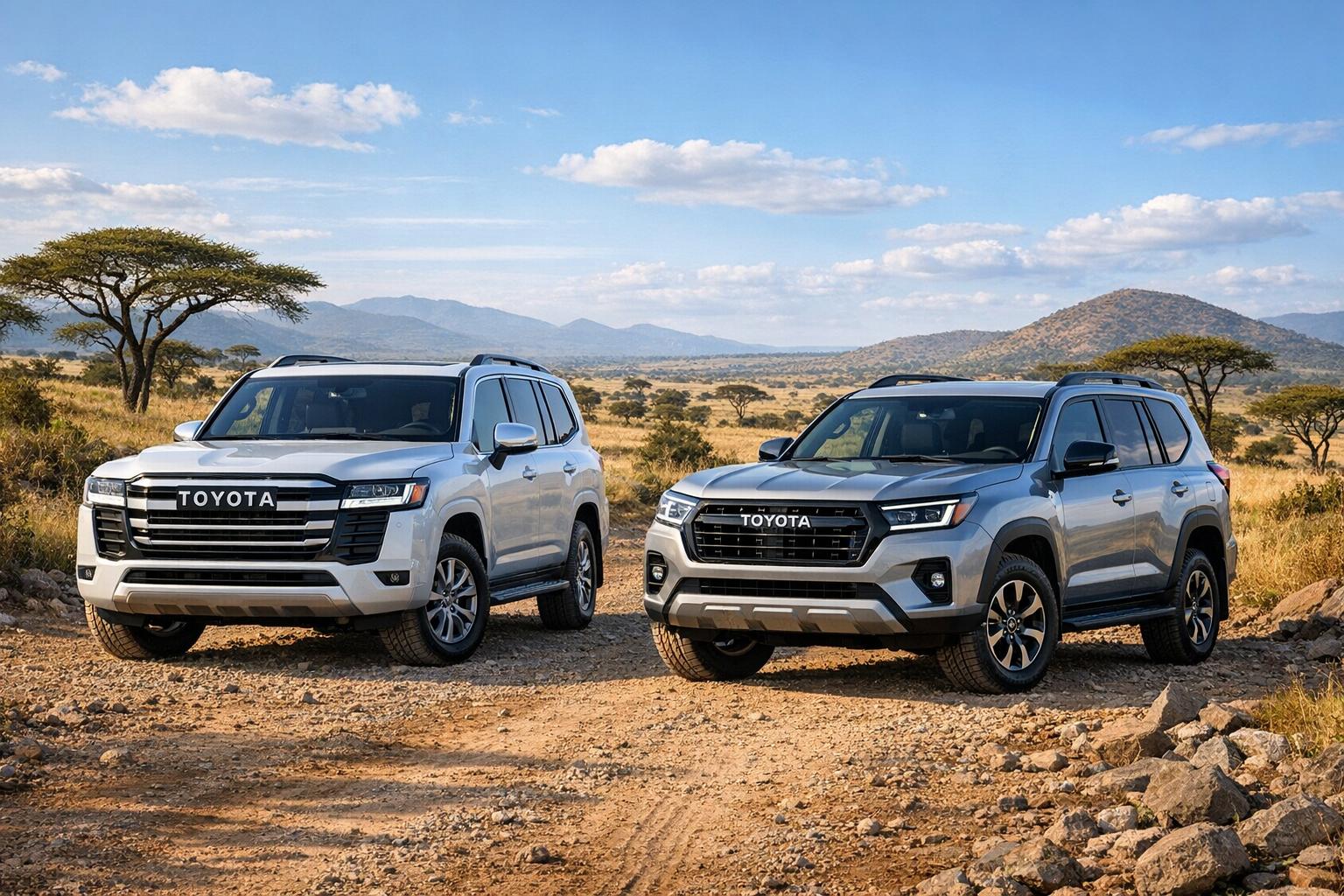
If you’re trying to decide between the Toyota Land Cruiser 300 and the Toyota Prado 250 in 2026, here’s what you need to know:
- Land Cruiser 300: A more powerful, rugged SUV with a 3.3L twin-turbo diesel engine (700Nm torque) and advanced off-road features. It’s perfect for extreme terrains, heavy towing (up to 3,500kg), and long-distance travel. Starting price: $88,000.
- Prado 250: A practical choice with a 2.8L turbo diesel engine (500Nm torque), better fuel efficiency (8.5L/100km), and a lower price tag. It’s ideal for city driving and moderate off-road use. Starting price: $79,000.
Quick Comparison
| Feature | Land Cruiser 300 | Prado 250 |
|---|---|---|
| Engine | 3.3L Twin-Turbo V6 Diesel | 2.8L Turbo-Diesel I4 |
| Torque | 700Nm | 500Nm |
| Fuel Efficiency | 8.9L/100km | 8.5L/100km |
| Ground Clearance | 245mm | 221mm |
| Price | $88,000 | $79,000 |
| Best For | Extreme off-road & towing | City & moderate off-road |
Choose the Land Cruiser if you need maximum power and durability for rugged adventures. Opt for the Prado if you want a more affordable, fuel-efficient SUV that’s easier to handle in urban settings.
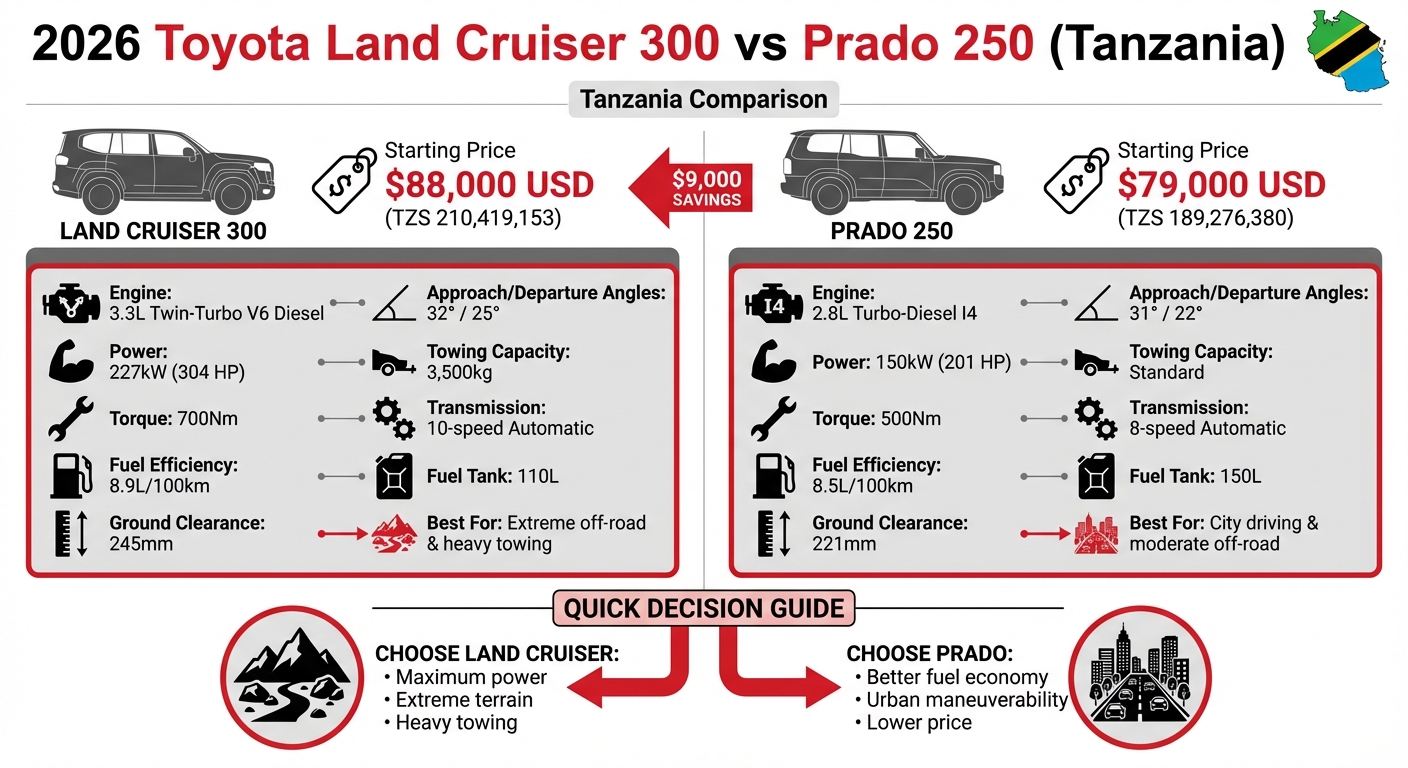
Toyota Land Cruiser 300 vs Prado 250 Comparison 2026 Tanzania
Is A V6 Worth $40K More? (Toyota Land Cruiser 300 Series vs Prado 250 Series 2025 Comparison Review)
Toyota Land Cruiser Overview

The 2026 Toyota Land Cruiser 300 Series stands as Toyota’s premier off-road vehicle, specifically engineered to tackle tough terrains like those found in Tanzania. Built on the TNGA-F ladder frame, it boasts 20% improved rigidity, making it more capable of handling rugged rural roads and rocky trails that connect remote areas and national parks.
Specifications and Features
Under the hood, you’ll find two powerful engine options: a 3.3L twin-turbo diesel V6 delivering 304 horsepower and 700 Nm of torque (available between 1,600–2,600 rpm), and a 3.5L twin-turbo petrol engine with 409 horsepower. Both engines are paired with a 10-speed automatic transmission, offering a wide gear range to handle everything from crawling over obstacles to cruising comfortably on highways like those between Dar es Salaam and Arusha.
For off-road enthusiasts, the Land Cruiser offers 245 mm of ground clearance – 24 mm more than the Prado – along with 32° approach and 25° departure angles, and a 3,500 kg towing capacity. These features make it well-suited for navigating steep gullies, deep ruts, and other challenges common in safari or business travel.
Its advanced off-road technology includes the Electronic Kinetic Dynamic Suspension System (E-KDSS), which adjusts or disconnects stabilizer bars to maximize wheel articulation on uneven terrain. The vehicle also features Multi-Terrain Select and Crawl Control, systems that automatically manage throttle and braking to help drivers tackle deep sand, mud, and rocky inclines – conditions frequently encountered in Tanzanian national parks. Additionally, the 360-degree Multi-Terrain Monitor offers a clear view of hidden obstacles using four strategically placed cameras, making it easier to maneuver through tight bush trails.
These features collectively highlight the Land Cruiser’s capability, ensuring it performs exceptionally well in Tanzania’s demanding environments.
Why the Land Cruiser Works in Tanzania
The Land Cruiser 300 diesel model achieves a fuel consumption rate of around 8.9L/100km, which is quite efficient given its size and performance capabilities. With a starting price of TZS 210,419,153 (approximately $88,000), it’s a premium option designed for those seeking durability and reliability. While the price tag reflects its high-end features, it’s also justified by its ability to handle long cross-country journeys. Its large fuel tank minimizes the need for frequent refueling – a crucial advantage in remote areas where fuel stations are scarce.
Thanks to its power, impressive ground clearance, and advanced suspension systems, the Land Cruiser ensures smooth travel even on Tanzania’s unpaved roads, making it a dependable choice for both safari adventures and business trips.
Toyota Prado Overview
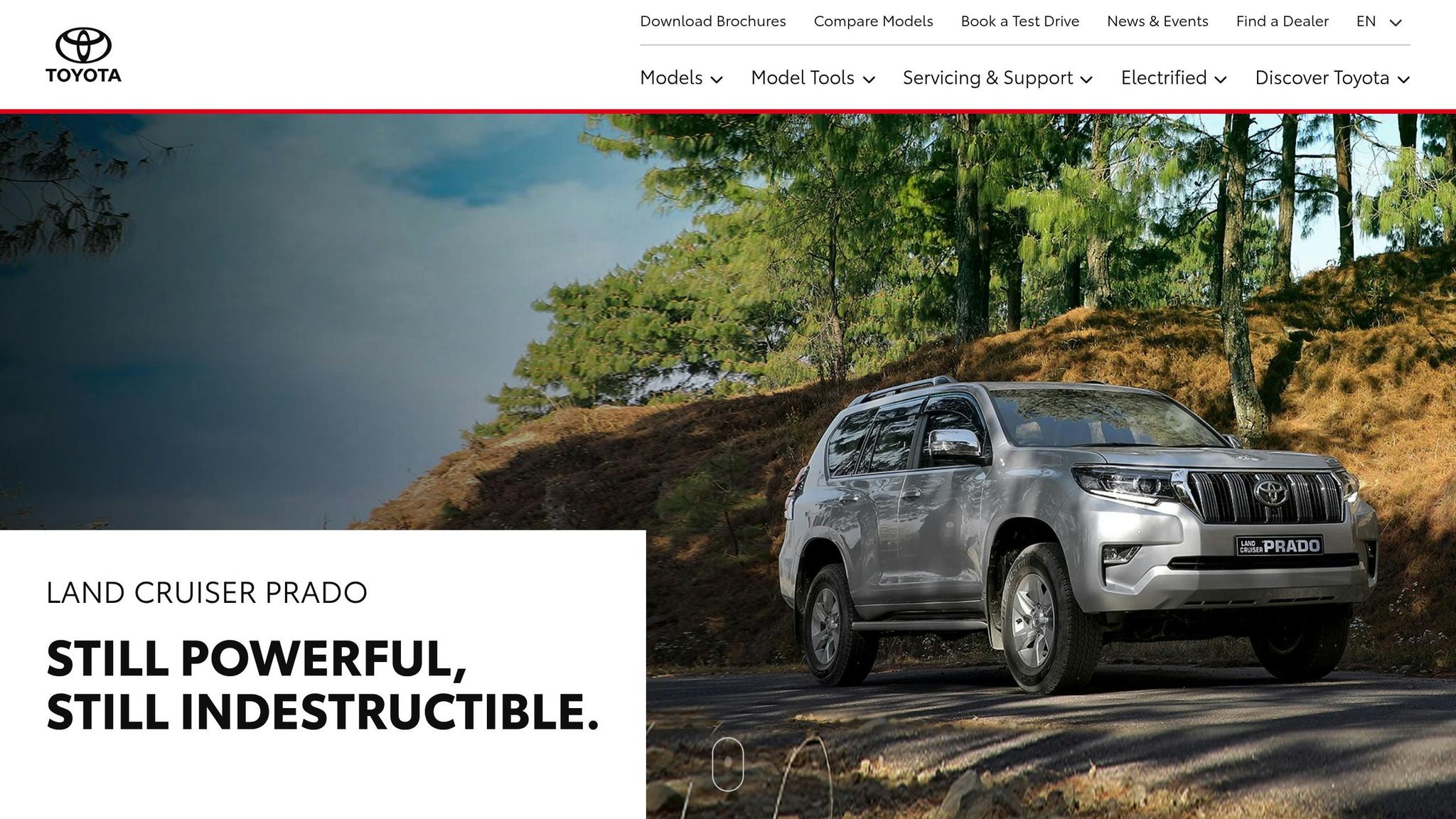
The 2026 Toyota Land Cruiser Prado (J250 series) is designed with practicality, durability, and reliability in mind. This model introduces a retro, boxy design built on the GA-F body-on-frame platform, which boasts a 50% increase in frame rigidity and a 30% improvement in overall structural rigidity compared to earlier versions. For Tanzanian drivers, the Prado offers a blend of everyday usability and off-road prowess, making it a dependable choice for both city commutes and weekend getaways. Let’s dive into the key specifications and features that set it apart.
Specifications and Features
The 2026 Prado is powered by a 2.8L turbo-diesel engine (1GD-FTV), delivering 201 horsepower and 500 Nm of torque. This engine is paired with an 8-speed automatic transmission for smooth performance. Its fuel efficiency is rated at approximately 8.5L/100km, making it slightly more economical than the Land Cruiser 300, which averages 8.9L/100km. Starting at TZS 189,276,380 (around $79,000), the Prado offers high-end features at a more accessible price point.
With a 221 mm ground clearance, the Prado is built to handle a variety of Tanzanian road conditions, from bumpy urban streets to moderately rough off-road paths. It features a 31° approach angle and a 22° departure angle, along with a full-time four-wheel-drive system that includes a Torsen limited-slip center differential and an electronic two-speed transfer case. Additionally, the Electric Power Steering (EPS) enhances low-speed maneuverability and integrates Lane Tracing Assist, making it especially useful in tight urban areas like Dar es Salaam.
Inside, the Prado comfortably seats seven across three rows, with premium leather upholstery and an updated infotainment system. Its 150-liter fuel tank (87L main, 63L auxiliary) ensures long-range travel. Safety features include ABS, Vehicle Stability Control (VSC), Active Traction Control (A-TRC), and curtain airbags for all three rows. For off-road enthusiasts, the Prado is equipped with Crawl Control, Multi-Terrain Select, and a Multi-Terrain Monitor with four cameras, making it well-suited for moderate off-road challenges.
Why the Prado Works in Tanzania
The Prado’s adaptability makes it an excellent choice for Tanzania’s varied driving conditions. In bustling cities like Dar es Salaam, its 5.8-meter turning radius and Electric Power Steering make navigating narrow streets and tight parking spots a breeze. Its robust suspension softens the impact of potholes and uneven roads, while its polished design fits seamlessly into professional environments – perfect for business owners who frequently travel to construction sites or remote locations.
On both urban and rural roads, the 2.8L diesel engine delivers dependable torque and durability. Its four-wheel-drive system ensures smooth handling on muddy roads during the rainy season and sandy coastal routes. Routine maintenance is straightforward; for example, cleaning the air filter after dusty trips can help maintain engine efficiency. The dual-tank fuel system provides ample range for cross-country travel, making journeys between towns more convenient. Additionally, the Prado’s wide availability of spare parts and strong resale value in Tanzania make it a practical and economical choice. Up next, we’ll compare these features with those of the Land Cruiser.
sbb-itb-d9186c2
Land Cruiser vs. Prado: Side-by-Side Comparison
Let’s take a closer look at how the Land Cruiser 300 and Prado 250 stack up in terms of performance, efficiency, and practicality for Tanzanian roads. While both models share a 2,850mm wheelbase, their differences become apparent when you dig into their capabilities, fuel economy, maintenance, and everyday usability.
Performance and Off-Road Ability
The Land Cruiser 300 brings serious muscle and off-road prowess. With its 3.3L twin-turbo V6 diesel engine producing 700Nm of torque – 40% more than the Prado’s 500Nm – it’s a beast for towing up to 3,500kg and handling rugged terrain. It also boasts a higher ground clearance of 245mm compared to the Prado’s 221mm, and its approach and departure angles (32° and 25° respectively) give it an edge on steep trails.
On the other hand, the Prado 250 benefits from its updated GA-F ladder frame platform, which improves frame rigidity by 50%. It’s equipped with a front sway-bar disconnect for better wheel articulation on uneven terrain. Both models feature advanced off-road tech like multi-terrain select, crawl control, and locking differentials, ensuring they can handle mud, sand, and rocky paths with confidence.
| Feature | Land Cruiser 300 | Prado 250 |
|---|---|---|
| Engine | 3.3L Twin-Turbo V6 Diesel | 2.8L Turbo-Diesel I4 |
| Power | 227kW | 150kW |
| Torque | 700Nm | 500Nm |
| Ground Clearance | 245mm | 221mm |
| Approach/Departure Angles | 32° / 25° | 31° / 22° |
| Transmission | 10-speed Automatic | 8-speed Automatic |
| Best For | Tough off-road challenges and heavy towing | Moderate off-roading with urban flexibility |
Now, let’s examine their fuel efficiency and maintenance costs to see how they compare in terms of long-term affordability.
Fuel Efficiency and Maintenance Costs
For those watching their budget, the Prado 250 is a more economical choice. It delivers better fuel efficiency at 8.5L/100km versus the Land Cruiser 300’s 8.9L/100km. Pricing also favors the Prado, starting at TZS 189,276,380 (roughly $79,000), which is about TZS 21 million less than the Land Cruiser’s starting price of TZS 210,419,153 (around $88,000).
When it comes to maintenance, the Land Cruiser series averages around $6,472 over the first 10 years, with a 16.61% chance of needing a major repair during that time. Annual maintenance costs begin at $307 in the first year and can climb to $934 by the tenth year. The Land Cruiser 300 requires servicing every 6 months or 10,000 km.
| Factor | Land Cruiser 300 | Prado 250 |
|---|---|---|
| Fuel Consumption | 8.9L/100km | 8.5L/100km |
| Starting Price (TZS) | 210,419,153 | 189,276,380 |
| 10-Year Maintenance Cost | ~$6,472 | Comparable within the series |
| Service Interval | Every 6 months / 10,000 km | Standard intervals as recommended |
| Spare Parts Availability | High in Tanzania | High in Tanzania |
Let’s move on to how these vehicles handle in everyday driving scenarios.
Size, Maneuverability, and Daily Use
For city driving, the Prado 250 has the upper hand. Its Electric Power Steering (EPS) makes navigating tight spaces and crowded streets a breeze. Its slightly smaller dimensions and 221mm ground clearance make it ideal for urban environments like Dar es Salaam.
The Land Cruiser 300, however, offers a more spacious interior and a 110L fuel tank, making it a better fit for long-distance travel. Meanwhile, the Prado’s 150L tank and compact design strike a balance between city use and extended range.
"Choose the Prado 250 if you want a practical, family-friendly 4WD with excellent off-road capability, better fuel efficiency, and a more affordable price point." – Sunshine Toyota
| Feature | Land Cruiser 300 | Prado 250 |
|---|---|---|
| Wheelbase | 2,850mm | 2,850mm |
| Overall Length | Slightly longer than the Prado | 4,925mm |
| Steering | Traditional hydraulic/electronic | Electric Power Steering (EPS) |
| Urban Suitability | Moderate due to larger footprint | High – easier maneuverability |
| Fuel Tank Capacity | 110L (80L + 30L) | 150L |
| Best For | Long trips and spacious interiors | City driving and mixed use |
Technology and Safety Features
Both SUVs come loaded with advanced safety and tech features. The Land Cruiser 300 includes adaptive cruise control and higher trims offer advanced driver-assistance systems. Meanwhile, the Prado 250 provides a 360° camera and panoramic view monitor, which are particularly useful for urban driving.
Inside, the Prado seats seven and offers premium leather upholstery, an updated infotainment system, and 3-zone automatic climate control for enhanced comfort. Both models include Lane Tracing Assist to improve highway safety.
| Feature | Land Cruiser 300 | Prado 250 |
|---|---|---|
| Seating Capacity | Varies by trim | 7 passengers |
| Key Safety Features | ABS, VSC, A-TRC, with available adaptive cruise control and Lane Tracing Assist | ABS, VSC, A-TRC, curtain airbags, plus available 360° camera and panoramic view monitor |
Which Vehicle Should You Choose in 2026?
When deciding between these two vehicles, it all comes down to your driving habits and what you need from your car. The best choice for 2026 depends on how well the vehicle matches your daily routines and any off-road adventures you have in mind.
If you’re looking for a versatile option that performs well in both city and off-road settings, the Toyota Land Cruiser Prado is a solid pick. It handles a variety of terrains with ease, making it ideal for navigating the bustling streets of Dar es Salaam or heading out for a weekend escape to places like the Serengeti or the highlands near Arusha. Plus, with its lower price and better fuel economy, it’s a practical choice for most drivers.
"The Toyota Land Cruiser Prado is all the car you will ever need. It is good-looking, comfortable, spacious, capable, practical, wears its reputation with pride and will probably last forever." – Jaco Van Der Merwe, Head of Motoring, The Citizen
On the other hand, if your lifestyle demands serious towing power or you frequently tackle extreme off-road conditions, the Toyota Land Cruiser is the way to go. With a price tag of TZS 210,419,153 (around $88,000), its 700Nm V6 diesel engine offers unmatched strength and durability. However, this level of performance requires regular maintenance – every six months or 10,000 km.
So, whether you prioritize fuel efficiency and city convenience or need a powerhouse for rugged adventures, your choice between the Prado and the Land Cruiser should reflect what fits your lifestyle best.
FAQs
How do the off-road capabilities of the Toyota Land Cruiser 300 and Prado 250 compare for Tanzanian terrain?
The Toyota Land Cruiser 300 and Prado 250 are both standout performers when it comes to off-road adventures, but the Land Cruiser 300 takes the lead for those tackling Tanzania’s most challenging landscapes. With a ground clearance of 9.1 inches compared to the Prado 250’s 8.7 inches, and a more powerful V6 engine delivering approximately 305 hp and 516 lb-ft of torque, the Land Cruiser 300 is built for steep climbs and navigating through deep ruts. On the other hand, the Prado 250’s engine produces 201 hp and 369 lb-ft of torque, making it a dependable choice for a mix of city driving and off-road excursions.
Both vehicles are built on Toyota’s advanced TNGA-F platform and come equipped with modern 4WD technologies such as electronic traction control and selectable driving modes. The Land Cruiser 300, however, steps it up with a sturdier suspension system and a standard rear-locking differential on higher trims. The Prado 250, while offering a rear differential as well, includes it as an optional feature on lower trims.
If you’re after maximum durability and unmatched off-road capability, the Land Cruiser 300 is the clear winner. But for those who want a lighter, more affordable option that comfortably handles both urban and rugged terrains, the Prado 250 is a solid pick.
Which is more fuel-efficient for long-distance travel: the Toyota Prado 250 or the Land Cruiser 300?
The Toyota Prado 250 stands out as a more fuel-efficient option for long drives, consuming roughly 7.9 liters per 100 kilometers (about 29.8 mpg). In comparison, the Land Cruiser 300 averages around 8.9 liters per 100 kilometers (about 26.4 mpg). This difference of about 1 liter less fuel per 100 kilometers makes the Prado a smarter pick for anyone looking to cut down on fuel costs during extended trips.
Which Toyota is better for city driving in Tanzania?
The Toyota Prado stands out as a practical option for navigating urban areas in Tanzania. Its smaller size compared to the larger Land Cruiser makes it much easier to handle in tight city streets and heavy traffic. Plus, with an average fuel efficiency of about 21 mpg combined, it’s a cost-effective choice for daily commuting.
Another advantage is its affordability. The Prado comes with a lower initial price tag while still delivering the comfort, reliability, and durability that Toyota vehicles are celebrated for. This combination makes it a dependable pick for city residents looking for a trustworthy car for everyday use.