If you’re starting or upgrading your taxi business in Tanzania, choosing the right car is critical for maximizing profits. Here’s a quick summary:
- Toyota Probox: Reliable and durable, ideal for rough roads and long hours. Affordable second-hand options with low maintenance costs.
- Suzuki Alto: Budget-friendly and fuel-efficient, perfect for city driving with low upfront and operational costs.
- Nissan Datsun Go: Affordable, easy to maintain, and fuel-efficient. Suitable for mixed city and rural routes.
- Toyota Prius (Hybrid): Excellent for saving on fuel in city traffic. Higher upfront cost but long-term savings with proper maintenance.
- BYD Dolphin (Electric): Emerging EV option with low running costs and government incentives, great for urban drivers.
Quick Comparison
| Model | Affordability | Fuel Efficiency | Durability | Maintenance Costs |
|---|---|---|---|---|
| Toyota Probox | High (Strong resale) | Good (1.3L–1.5L engines) | Very High | Low |
| Suzuki Alto | Very High (Low upfront) | Excellent (Small engine) | Moderate (City use) | Very Low |
| Nissan Datsun Go | High (Budget-friendly) | High (Sub-1,300cc) | Moderate | Low |
| Toyota Prius | Moderate (Higher cost) | Excellent (Hybrid) | High | Moderate (Battery risk) |
| BYD Dolphin | Moderate (EV incentives) | Excellent (Electric) | High | Low |
Each car has strengths depending on your budget, route type, and fuel priorities. For city-focused drivers, the Suzuki Alto or Toyota Prius are great choices. For mixed or rural routes, the Toyota Probox or Nissan Datsun Go offer reliability and durability. Electric options like the BYD Dolphin are promising for urban drivers looking to cut long-term costs.
Your choice should align with your driving needs and financial goals. Let’s dive into the details.
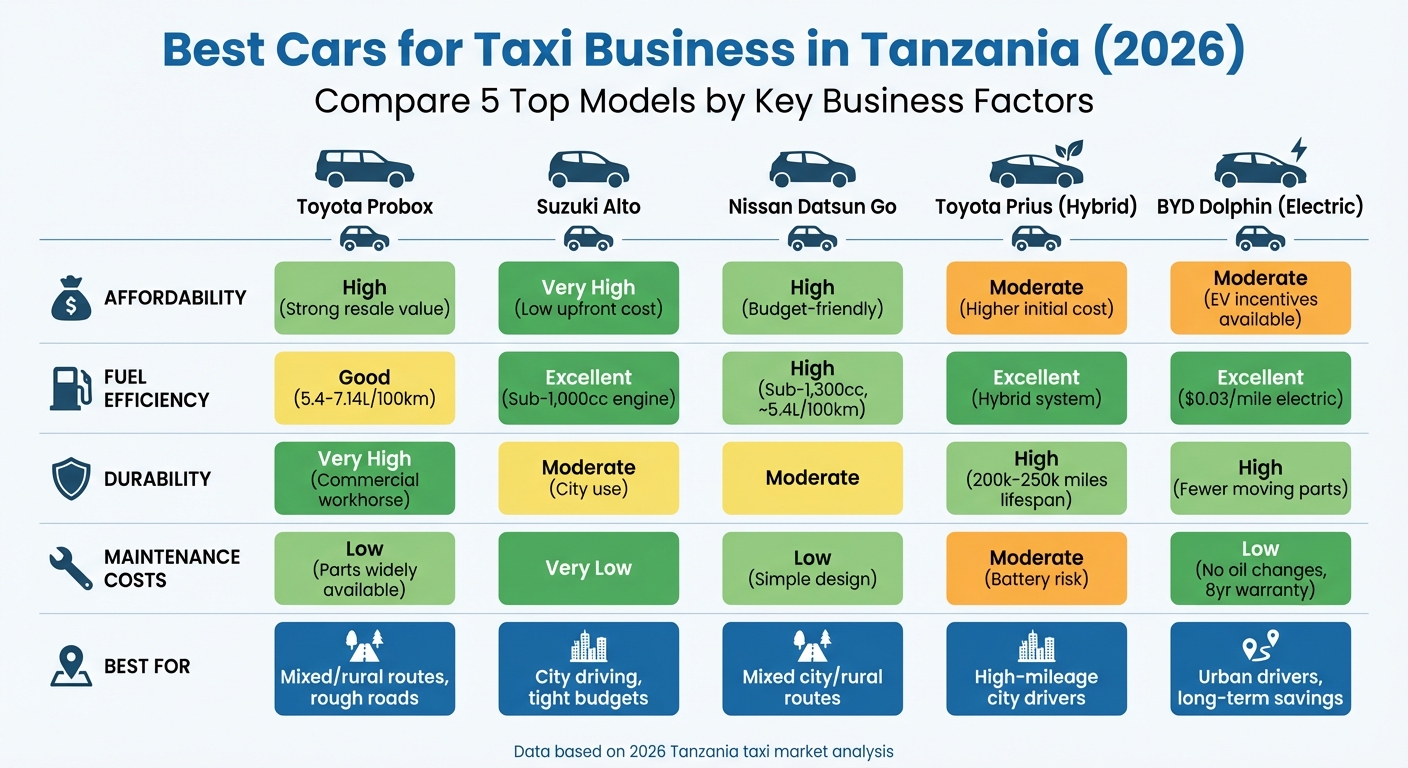
Best Taxi Cars in Tanzania 2026: Comparison of Affordability, Fuel Efficiency, Durability and Maintenance Costs
1. Toyota Probox
The Toyota Probox has cemented itself as a dependable choice in Tanzania’s taxi industry. Known for its reliability, cost-effectiveness, and ability to handle the demands of daily use, this compact station wagon is a common sight on the streets of Dar es Salaam and beyond. Its reputation for durability and efficiency makes it a go-to vehicle for drivers seeking a practical and affordable workhorse.
Affordability
One of the key reasons the Probox is so popular is its affordability. Thanks to Tanzania’s robust market for second-hand Japanese imports, used models from 2003 onward are available at significantly lower prices than new cars. On top of that, the Probox holds its value well, allowing drivers to recover a good portion of their investment when upgrading to a newer model. This combination of low upfront costs and high resale value makes it a smart financial choice for taxi operators.
Fuel Efficiency
Fuel efficiency is another area where the Probox shines. With consumption rates ranging between 5.4L/100KM and 7.14L/100KM, it helps keep daily operating costs under control. For drivers, this translates to better profit margins without sacrificing performance.
Durability
Built to handle rough terrain, potholes, and long hours on the road, the Probox lives up to Toyota’s reputation for durability. Toyota Tanzania backs this with 24/7 Roadside Assistance and a network of service centers, even in smaller towns. This support ensures that drivers can rely on their vehicles without worrying about extended downtime.
Maintenance Costs
Maintenance is another area where the Probox proves its worth. Spare parts are widely available across Tanzania, keeping repair costs reasonable and ensuring quick turnarounds. Programs like "Automark" provide access to authorized technicians and genuine parts, helping maintain the vehicle’s performance and resale value. Less time in the shop means more time earning on the road, making the Probox a solid investment for any taxi driver.
2. Suzuki Alto
The Suzuki Alto is a budget-friendly, nimble alternative for operators, complementing vehicles like the Probox. Officially approved for UberX services in Tanzania, this compact hatchback is a smart choice for drivers entering the ride-hailing market or expanding their taxi fleet. Its compact design and efficient build make it an excellent fit for maneuvering through the bustling streets of cities like Dar es Salaam.
Affordability
The Alto is one of the most cost-effective options in Tanzania’s taxi market. While exact pricing for 2026 isn’t widely available, it competes in the entry-level hatchback category, where similar models like the Toyota Starlet are priced around TZS 33,026,373. Typically, the Alto is even more affordable, making it a great choice for drivers looking to minimize upfront investment. With an engine size of less than 1,000cc, it also keeps maintenance and operational costs manageable.
Fuel Efficiency
Fuel efficiency is a standout feature of the Alto. Its sub-1,000cc engine uses significantly less fuel compared to other taxi-approved vehicles like the Toyota Vitz and Nissan March, which often come with 1,300cc engines. This smaller engine size translates to lower fuel consumption, helping drivers save on daily operating costs and boosting profit margins. For those looking to reduce expenses, the Alto offers a clear advantage with its outstanding fuel economy.
Maintenance Costs
Keeping the Alto in good shape is simple and inexpensive. Spare parts are widely available, and the straightforward design ensures minimal downtime and repair costs. Models from 2003 onwards qualify for taxi operations, provided they are in solid condition and free from cosmetic damage. This reliability and ease of maintenance make the Alto an appealing option for taxi operators.
3. Nissan Datsun Go
The Nissan Datsun Go is a budget-friendly and dependable option for taxi operators looking for a vehicle that balances cost and reliability. As part of Nissan’s Datsun sub-brand, this 4-door hatchback meets the ride-hailing requirements in Tanzania and directly competes with entry-level models like the Toyota Passo and Suzuki Alto. Let’s take a closer look at why it’s a smart choice for taxi drivers.
Affordability
The Datsun Go stands out as one of the most wallet-friendly options for those stepping into the taxi business. With pricing that rivals models such as the Toyota Starlet (approximately TZS 33,026,373), it offers great value. Certified pre-owned models are often available at up to 25% less than new ones and frequently come with extended warranties. Globally, Nissan has positioned its budget-friendly vehicles, like the Versa, with starting prices as low as $17,190 in the U.S. market. This combination of an affordable purchase price and low maintenance costs can significantly boost profit margins for taxi operators.
Fuel Efficiency
Fuel expenses are a major consideration for taxi drivers, who often log high mileage. The Datsun Go’s efficient sub-1,300cc engine helps keep fuel consumption in check. Competing with models like the Toyota Starlet, it achieves an impressive fuel economy of about 5.4L/100KM. For drivers navigating city streets daily, this translates into noticeable savings on fuel costs each week.
Maintenance Costs
When it comes to upkeep, the Datsun Go’s straightforward mechanical design is a big advantage. Repairs are simpler and more affordable, reducing both costs and downtime. Regular maintenance is easy to manage, ensuring the vehicle stays operational and avoids expensive repair bills. This simplicity helps drivers keep their earnings steady without the worry of unexpected mechanical issues.
4. Toyota Prius (Hybrid)
The Toyota Prius brings hybrid efficiency to Tanzania’s taxi industry, making it a smart choice for cutting fuel expenses in city traffic. As Arif Hasnat from Carbarn Tanzania explains:
"If you want to slash fuel bills in city traffic, hybrids like the Prius are smart picks. Confirm the battery health before buying."
Fuel Efficiency
The Prius truly shines when it comes to fuel savings. Traditional vehicles typically consume 5.4–6.2L/100KM, but the Prius significantly lowers these figures, especially in heavy, stop-and-go traffic where taxis often operate. This efficiency means drivers can save a substantial amount on fuel each week, directly increasing their profits. Its hybrid system even recycles energy during braking, making it perfect for urban routes.
Maintenance Costs
Over a decade, maintaining a Prius costs around $4,360 – $515 less than the average for hatchbacks. In the first year, annual maintenance costs start at approximately $199 and gradually rise to about $636 by the tenth year. Features like regenerative braking help extend the life of brake pads, and the continuously variable transmission (CVT) has fewer moving parts compared to traditional systems. Additionally, the Prius has a lower major repair rate (11.58%) compared to similar vehicles (14.64%). Toyota Tanzania offers official aftersales support with genuine parts and skilled technicians, ensuring long-term reliability and protecting your investment.
Durability
Known for its durability, the Prius boasts a 4.5/5 reliability rating and can last between 200,000 and 250,000 miles with proper maintenance. Jonathan Diaz from Capital Motor Cars highlights this strength:
"The Prius’ hybrid engine system, along with its proven track record for durability, makes it a standout in the hybrid market."
Before purchasing a used Prius, it’s essential to get a professional battery diagnostic since replacement costs can be high. For vehicles with high mileage, inspect suspension components like bushings and shocks, as these can wear out quickly on Tanzania’s rougher roads . The Prius is best suited for paved city roads in areas like Dar es Salaam, Dodoma, and Arusha. For rural routes with uneven terrain, a vehicle with higher ground clearance would be a better fit. Despite its higher upfront price, the Prius’s durability and reliability make it a worthwhile investment.
Affordability
The initial cost of a Prius can vary, but certified pre-owned models often provide better value. When considering a purchase, remember Tanzania’s import taxes: a 25% Import Duty, 18% VAT, 5% Excise Duty for engines in the 1,001–2,000cc range, and a 2% Railway Development Levy. Additionally, vehicles older than 8 years incur extra excise duties. To estimate landing costs, use the Tanzania Revenue Authority‘s calculator. Recent government incentives promoting cleaner transportation make hybrids like the Prius even more appealing for taxi operators looking to the future. With its fuel efficiency and lower maintenance costs, the Prius offsets its higher upfront price, delivering long-term profitability.
sbb-itb-d9186c2
5. BYD Dolphin (Electric)
The BYD Dolphin is making waves in Tanzania’s taxi industry, offering an affordable and efficient electric vehicle option. With government tax breaks and lower operational costs, this EV is priced between $20,000 and $25,000. Let’s dive into how its affordability, efficiency, maintenance, and durability make it a smart choice for taxi operators.
Affordability
While the Dolphin costs more than budget hatchbacks, Tanzania’s government incentives – like a 100% VAT exemption and 0% excise duty – help offset the higher upfront cost. After factoring in a 25% import duty and a 2% Railway Development Levy, the Dolphin Active’s CIF value comes to about $11,800. BYD’s in-house production of batteries and motors further drives down purchase and maintenance expenses, making it $10,000 to $15,000 cheaper than comparable Tesla models.
As Younes Rabeh from African EV Market News puts it:
"For a typical driver in Dar es Salaam or Arusha, this [switching to an EV] can translate into millions of shillings saved over the life of the car."
The Dolphin also holds its value well, retaining 65–75% of its worth after three years, which makes it a solid long-term investment.
Fuel Efficiency
Electric vehicles like the Dolphin cost as little as $0.03 per mile to drive. Features such as home charging and regenerative braking ensure ample daily range while reducing brake wear. The Tanzanian EV market is also expected to grow at an annual rate of 40.5% from 2025 to 2030, with public charging stations becoming more common in cities and along highways.
Maintenance Costs
The Dolphin’s electric drivetrain eliminates the need for oil changes, spark plugs, and exhaust repairs, significantly lowering maintenance costs. It comes with an 8-year/100,000-mile battery warranty and a 3-year/36,000-mile basic warranty, giving drivers peace of mind. Routine tasks like annual battery diagnostics and tire pressure checks keep the car running smoothly, and a Level 2 charger can improve charging speed and efficiency.
Durability
Built with BYD’s Blade Battery using LFP (lithium iron phosphate) chemistry, the Dolphin is designed for safety and longevity – perfect for demanding taxi work in tough conditions. Some models even offer sodium-ion battery options, which can cut costs by 8–12%. The Dolphin’s quiet and smooth ride enhances passenger comfort, making it a favorite for ride-hailing services.
Advantages and Disadvantages
Here’s a quick breakdown of the strengths and weaknesses of each vehicle model:
| Model | Affordability | Fuel Efficiency | Durability | Maintenance Costs |
|---|---|---|---|---|
| Toyota Probox | High (Strong resale value) | Good (1.3L–1.5L engines) | Very High (Commercial workhorse) | Low (Parts available everywhere) |
| Suzuki Alto | Very High (0% excise duty for engines up to 1,000 cc) | Excellent (Small engine) | Moderate (City-focused) | Very Low |
| Nissan Datsun Go | High (Budget-friendly) | High | Moderate | Low (Nissan parts ecosystem) |
| Toyota Prius | Moderate (Higher import cost) | Excellent (Hybrid system) | High | Moderate (Battery degradation risk) |
| BYD Dolphin | Moderate (Excise exempt) | Excellent (Electric) | High (Fewer moving parts) | Low (Requires specialized service) |
This comparison lays out the key factors to consider when selecting a vehicle for your business.
The Suzuki Alto shines when it comes to upfront affordability, making it a great option for those on a tighter budget. Meanwhile, the Toyota Probox is a standout for durability and its easy access to spare parts, making it a reliable workhorse. For those looking to minimize fuel costs, the Toyota Prius and BYD Dolphin are strong contenders, but it’s crucial to thoroughly inspect the battery condition, as battery issues might not be apparent during a short test drive.
These insights can help you pick a vehicle that balances cost, efficiency, and reliability – perfect for maximizing profits in Tanzania’s taxi market.
Conclusion
Selecting the best vehicle for your taxi business in Tanzania hinges on two key factors: your operating environment and your budget. For those navigating the busy streets of Dar es Salaam and aiming to minimize upfront costs, the Suzuki Alto is a standout choice. Its exemption from excise duty and low maintenance costs make it a budget-friendly option. On the other hand, if you need a vehicle that can handle both urban traffic and rougher roads, the Toyota Probox is a time-tested workhorse. Its durability, availability of spare parts, and strong resale value make it a reliable investment.
For city drivers who rack up significant mileage, hybrids like the Toyota Prius or electric options such as the BYD Dolphin offer long-term savings. Just make sure to get a professional battery diagnostic before purchasing. Additionally, government excise duty exemptions for electric vehicles can help reduce the initial purchase cost, making them more accessible.
If your routes extend to up-country areas or rougher terrains, prioritize vehicles with a ground clearance of 170–200 mm (6.7–7.9 inches). The Nissan Datsun Go offers a good balance of affordability and versatility for these routes, though it may not match the Toyota Probox in durability.
Ultimately, profitability comes down to choosing a vehicle that fits your specific operating conditions. Consider the nature of your routes, your capital, and your fuel budget. As Carbarn.tz aptly put it:
"Tanzania is a big, beautiful driving country… that diversity shapes the car market: people want durable vehicles with good ground clearance for mixed road conditions, city friendly hybrids to tame fuel costs, and commercial workhorses."
The key is to match your vehicle choice to your actual driving needs – not just to the one with the cheapest price tag.
FAQs
What should I consider when choosing a car for a taxi business in Tanzania?
When choosing a car for a taxi business in Tanzania, it’s important to think beyond the sticker price. The total cost of ownership should be your focus, factoring in expenses like import duties (which range from 32% to 65% depending on engine size), registration fees (around $77 to $116), and insurance (roughly 3.5% to 4% of the car’s value). To save on these costs, consider a vehicle with a smaller engine – anything under 1,300 cc can significantly lower taxes and insurance premiums.
Fuel efficiency is another big consideration. Look for cars that deliver 15–22 km/L, as this will help you save on fuel over time. Durability is equally important; you’ll want a model with good ground clearance (at least 150 mm) to handle the varied road conditions in Tanzania. Additionally, make sure spare parts are readily available to keep maintenance costs manageable. Brands like Toyota and Suzuki are widely favored for their dependability and low repair expenses.
Finally, ensure the vehicle meets local requirements. It must be a 2003 model year or newer, have four doors, be commercially registered, and come equipped with valid insurance. The car should also be in good working condition, with functional air conditioning and windows. Staying compliant with these regulations not only helps you avoid fines but also keeps your vehicle on the road, ensuring smoother operations and better profitability.
How do government incentives make electric vehicles more affordable for taxi operators in Tanzania?
Tanzania is making electric vehicles (EVs) more affordable for taxi operators through targeted government incentives. One of the key changes is the removal of excise duties on EVs, which significantly cuts down the upfront cost. Although the standard 20% VAT and 25% import duty still apply, the overall tax load is much lighter compared to traditional vehicles. There’s also a HIV Response Levy – a small fee ranging from about $40 to $105, depending on the battery size – but this is a minor expense when weighed against the long-term benefits.
Switching to EVs offers substantial savings for taxi operators. Without fuel costs and with less engine maintenance required, drivers can save thousands of dollars over the lifespan of the vehicle. When paired with the reduced import taxes, EVs become not just an environmentally friendly option but also a financially smart one for Tanzania’s taxi drivers.
What is the best car for taxi routes that include both city and rural areas in Tanzania?
For taxi operators navigating both city streets and rural roads in Tanzania, the Toyota Corolla stands out as a solid option. With fuel efficiency ranging between 36–46 mpg, dependable performance, and a 5.9-inch ground clearance, it’s well-suited for handling uneven terrain while maintaining comfort and efficiency in urban settings.
For those who often face extremely rough roads, the Suzuki Escudo might be a better fit, thanks to its higher ground clearance of 7.9 inches. That said, for most mixed-use routes, the Corolla strikes a great balance of reliability, affordability, and practicality, making it a favorite among taxi operators aiming to meet diverse passenger needs.
Related Blog Posts
- Best used cars in Tanzania 2025
- Car prices in Dar es Salaam
- Top 5 Budget Cars Under TSh 20 Million in Tanzania
- Car Prices in Tanzania in 2025: What’s Affordable Now?