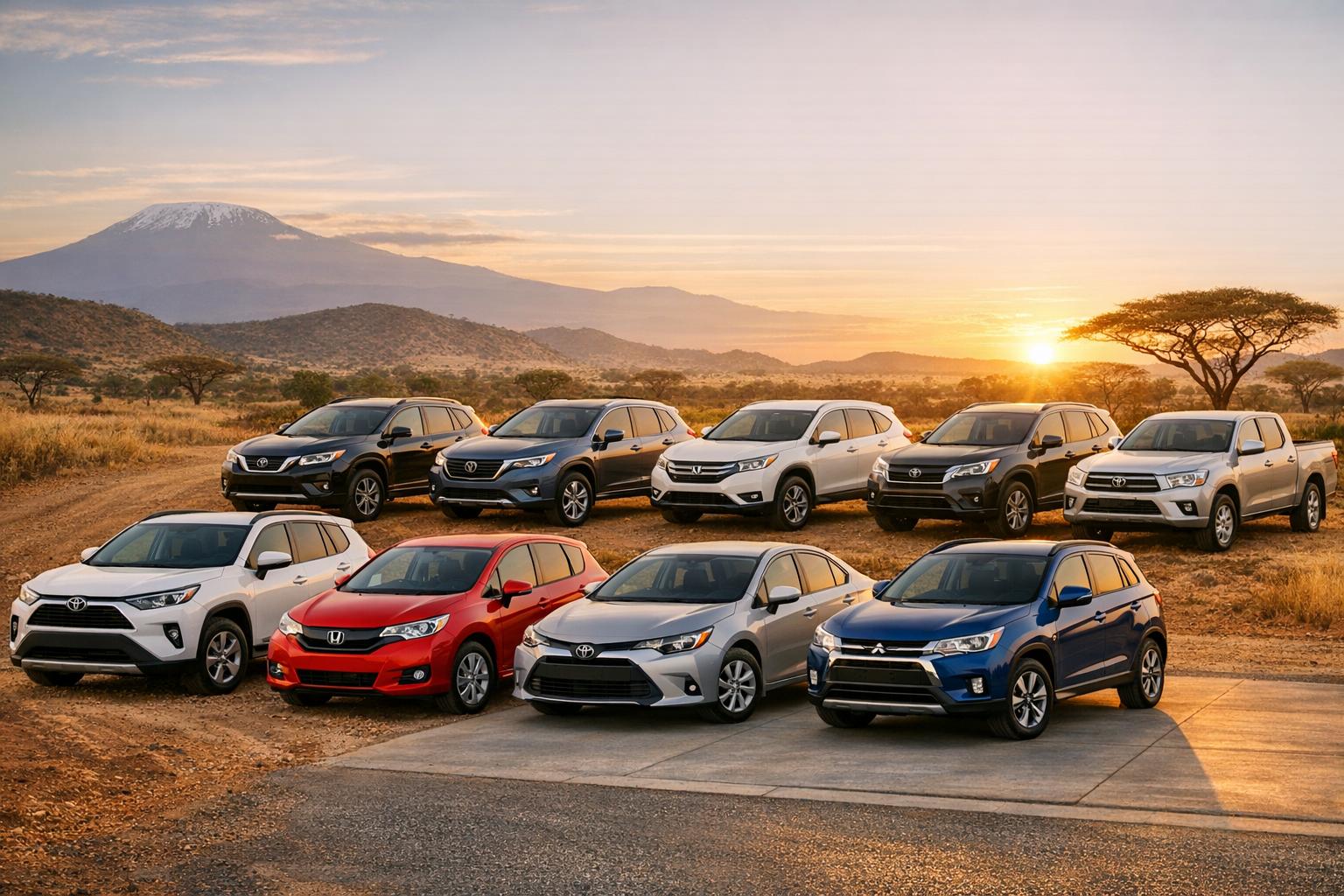
Tanzania’s tough road conditions demand cars with durability, fuel efficiency, and low maintenance costs. Japanese brands like Toyota, Nissan, and Honda dominate the market due to their reliability, availability of spare parts, and high resale value. While electric and hybrid cars are gaining traction thanks to government incentives, used vehicles remain the most popular choice.
Key Highlights:
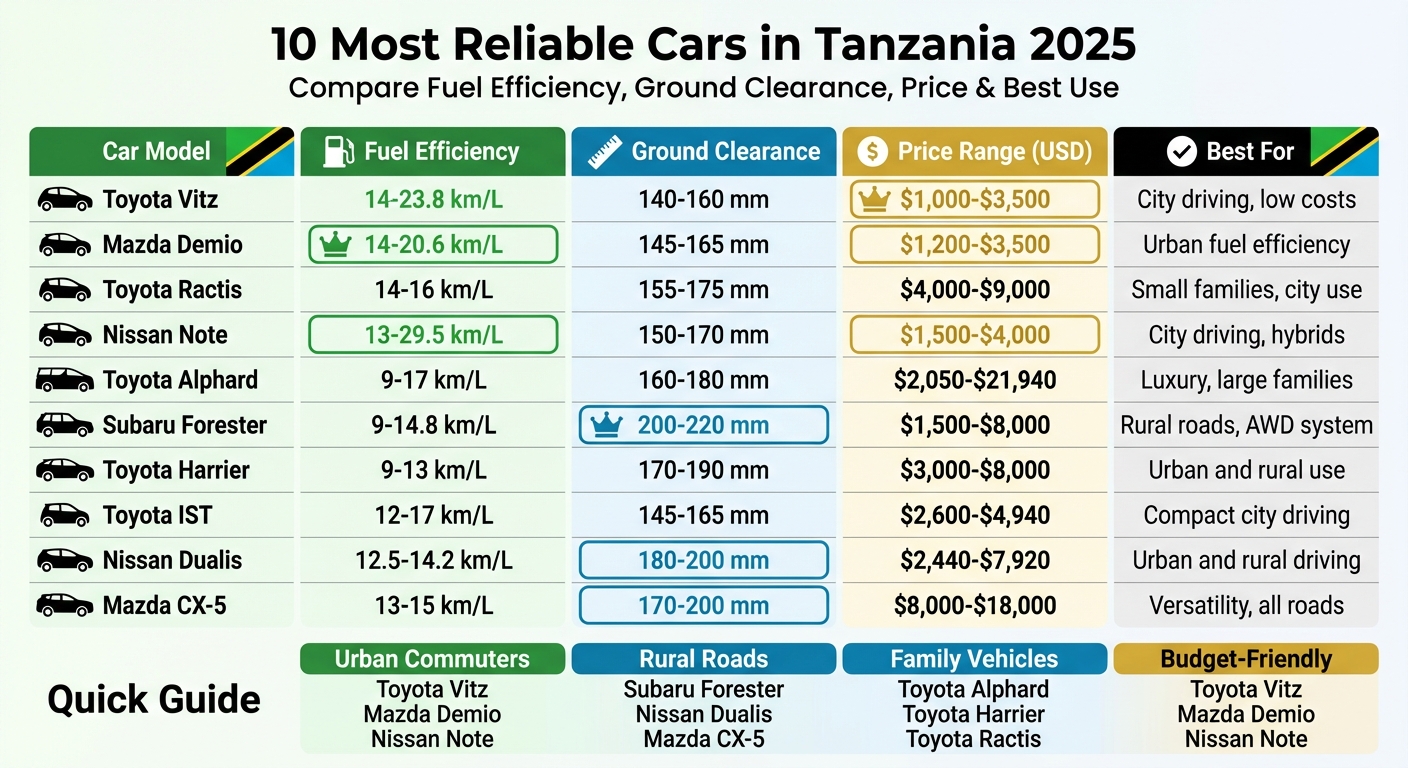
- Urban Commuters: Compact cars like the Toyota Vitz and Mazda Demio offer great fuel efficiency and are perfect for city driving.
- Rural Roads: SUVs like the Subaru Forester and Nissan Dualis handle rough terrain with high ground clearance and robust designs.
- Family Needs: Spacious options like the Toyota Alphard and Harrier provide comfort and practicality for larger groups.
- Budget-Friendly Options: Models like the Toyota IST and Nissan Note are affordable and easy to maintain.
Quick Comparison:
| Car Model | Fuel Efficiency (km/L) | Ground Clearance (mm) | Price Range (USD) | Best For |
|---|---|---|---|---|
| Toyota Vitz | 14–23.8 | 140–160 | $1,000–$3,500 | City driving, low costs |
| Mazda Demio | 14–20.6 | 145–165 | $1,200–$3,500 | Urban fuel efficiency |
| Toyota Ractis | 14–16 | 155–175 | $4,000–$9,000 | Small families, city use |
| Nissan Note | 13–29.5 | 150–170 | $1,500–$4,000 | City driving, hybrids |
| Toyota Alphard | 9–17 | 160–180 | $2,050–$21,940 | Luxury, large families |
| Subaru Forester | 9–14.8 | 200–220 | $1,500–$8,000 | Rural roads, AWD system |
| Toyota Harrier | 9–13 | 170–190 | $3,000–$8,000 | Urban and rural use |
| Toyota IST | 12–17 | 145–165 | $2,600–$4,940 | Compact city driving |
| Nissan Dualis | 12.5–14.2 | 180–200 | $2,440–$7,920 | Urban and rural driving |
| Mazda CX-5 | 13–15 | 170–200 | $8,000–$18,000 | Versatility, all roads |
Whether you need a small, fuel-efficient car for city commutes or a sturdy SUV for rural roads, this guide covers the top 10 models that meet Tanzania’s unique driving conditions.
Top 10 Most Reliable Cars in Tanzania 2025: Fuel Efficiency, Ground Clearance & Price Comparison
1. Toyota Vitz
Affordability (USD Price Range)
The Toyota Vitz comes with a price tag ranging from $1,000 to $3,500 USD for used imports. Its engine options, between 1,000cc and 1,500cc, are a major cost advantage. Engines under 1,000cc attract a 25% duty, while those between 1,000cc and 1,500cc are taxed at 35%, keeping import expenses manageable. On top of that, with excise duties as low as 0–5% and an 18% VAT, the overall cost makes the Vitz a budget-friendly choice for first-time car buyers.
Spare parts are easy to find, and maintenance is straightforward, ensuring low running costs and solid resale value. Combined with its reliable performance, the Vitz is a practical option for many.
Fuel Efficiency (km/L)
When it comes to fuel economy, older models typically offer 14–17 km/L, while the 2024/2025 versions push efficiency further, achieving up to 23.8 km/L (4.2L/100km). Models equipped with the "Stop-Start" feature – designed to turn off the engine when idle – can save even more fuel.
Suitability for Tanzanian Urban and Rural Conditions
The Vitz’s compact size makes it an excellent fit for urban life in Tanzania. It handles narrow streets and tight parking spaces with ease, making it a favorite for ride-hailing services and driving schools.
That said, it does have its limitations. Its low ground clearance isn’t ideal for unpaved rural roads, and the smaller engine can struggle on steep hills when carrying a full load. For those who frequently travel outside the city, it’s a good idea to regularly check components like bushings, shocks, and CV boots, as they can wear out faster on rough terrain.
2. Mazda Demio
Affordability (USD Price Range)
The Mazda Demio is a solid choice for those on a budget. Used models are available in a price range of $1,200 to $3,500 USD, with specific examples like 2010 models priced between $940 and $3,940, 2015 models ranging from $1,900 to $13,600, and 2019 models costing $4,540 to $9,720. Engine options include 1.3L and 1.5L variants, which fall in the 1,001cc to 2,000cc category, subjecting them to a 5% excise duty on imports. Thanks to its affordability and sleek European-inspired design, the Demio appeals to students and young professionals looking for an alternative to the Toyota Vitz or Nissan March.
However, while the price is appealing, it’s worth noting that spare parts can be pricier and harder to find, and servicing options are more limited compared to Toyota models.
Fuel Efficiency (km/L)
The Demio is not just affordable – it’s also efficient. Older DW models offer fuel economy of 14–14.5 km/L, DY models improve to 17.5–19 km/L, and newer DJ models equipped with Skyactiv-G technology can reach up to 20.6 km/L. On average, used models deliver a respectable 14–16 km/L.
Suitability for Tanzanian Urban and Rural Conditions
The Demio is well-suited for city life. Its compact design makes it a breeze to maneuver through Dar es Salaam’s crowded streets and fit into tight parking spaces.
As automotive journalist Josephat Lukaza puts it, "The Demio strikes a solid balance between performance, efficiency, and practicality for urban areas – but on rougher roads, higher ground clearance and AWD or 4WD are preferable".
That said, the Demio struggles on rough terrain. Its low ground clearance and lack of all-wheel drive make it less ideal for rural roads in Tanzania. For areas like Mbeya or Arusha, cars with higher ground clearance, such as the Toyota RAV4 or Nissan X-Trail, are better options. Additionally, some owners have noted issues like road noise at higher speeds and limited rear seat space, which can detract from comfort during longer trips.
3. Toyota Ractis
Affordability (USD Price Range)
The Toyota Ractis stands out as a budget-friendly and reliable subcompact vehicle. Its right-hand-drive configuration is perfectly suited for Tanzania’s left-side driving system. Adding to its appeal, Toyota’s strong presence in the market ensures that spare parts are easy to find, making maintenance straightforward and cost-effective.
But the Ractis isn’t just about affordability – it also shines when it comes to fuel efficiency.
Fuel Efficiency
Equipped with a 1.5L engine, the Ractis strikes a great balance between power and fuel economy. This is a key advantage, especially with fluctuating fuel prices. Engine options ranging from 1.5L to 2.0L have gained popularity among Tanzanian drivers for offering a mix of performance and practicality.
This fuel efficiency makes it a great choice for everyday use, though its performance may vary depending on the terrain.
Suitability for Tanzanian Urban and Rural Conditions
The Ractis is designed with urban driving in mind. Its compact size allows it to maneuver easily through congested streets and fit into tight parking spaces in cities like Dar es Salaam. However, its ground clearance falls below the recommended 170–200 mm for rural roads. This can pose challenges on unpaved roads, especially in regions like Arusha, Mwanza, and Dodoma, where potholes and rough terrain are common.
For those tackling more rugged conditions, models with higher ground clearance and sturdier suspension are better options. While the Ractis excels in urban settings, its low clearance makes it less suitable for off-road adventures.
4. Nissan Note
Affordability (USD Price Range)
The Nissan Note is one of the most wallet-friendly cars available in Tanzania, with used models typically priced between $1,500 and $4,000. This makes it a popular choice, especially for first-time buyers. Adding to its appeal, spare parts are readily available at Kariakoo Market in Dar es Salaam, which helps keep repair and maintenance costs in check.
What sets the Note apart is its fuel efficiency, making it a practical and economical option for city driving.
Fuel Efficiency (km/L)
For the standard petrol models, the Nissan Note offers an average fuel efficiency of 13–15 km/L. If you opt for the third-generation Note with the e-Power hybrid system, you can get an impressive 29.5 km/L. This level of fuel efficiency can make a noticeable difference in reducing fuel costs, especially for drivers navigating cities like Dar es Salaam, Dodoma, or Arusha. However, if you’re considering the hybrid version, it’s essential to check the condition of the battery before purchasing.
While the Note shines in fuel efficiency, its performance on rougher terrain is more limited.
Suitability for Tanzanian Urban and Rural Conditions
The Nissan Note is a great fit for urban settings. Its compact size makes it easy to navigate through crowded streets and squeeze into tight parking spaces. The interior is roomy enough for small families, making it a solid choice for daily city commutes. However, when it comes to rural areas, the Note’s lower ground clearance – less than the recommended 170–200 mm – can be a drawback. This makes it less suitable for unpaved roads or areas prone to potholes during the rainy season. If you plan to drive on rough terrain, be sure to inspect the undercarriage, especially the bushings and shocks, to avoid potential issues.
5. Toyota Alphard
Affordability (USD Price Range)
The Toyota Alphard stands out as a luxury minivan, and its price tag reflects that. For used models, a 2007 Alphard typically costs between $2,050 and $7,870, while 2010 models range from $2,400 to $21,940. If you’re eyeing the latest 2024 models, expect to pay anywhere from $43,940 to $109,540. Keep in mind, import taxes can significantly increase these prices – think 25% duty, 18% VAT, and up to 10% excise for engines larger than 2,000 cc. Additionally, vehicles older than eight years attract extra excise duties.
Maintenance is another factor to consider. The Alphard’s advanced suspension system and electronics require specialized servicing and genuine parts, which can make upkeep more expensive.
Fuel Efficiency (km/L)
Fuel economy for the Alphard varies widely, depending on the engine type. Early models with a 2.4L petrol engine deliver around 11 km/L, while the 3.0L V6 offers about 9 km/L. If you’re considering hybrid models, you’ll find better efficiency: the AH30 averages 17 km/L, and the AH40 achieves 16.7 km/L. For those navigating city traffic, hybrids can help reduce fuel costs. However, always check the health of the hybrid battery before purchasing.
Suitability for Tanzanian Urban and Rural Conditions
The Toyota Alphard is well-suited for Tanzanian urban areas but comes with some limitations for rural use. In cities like Dar es Salaam, Dodoma, and Arusha, it excels on smooth, paved roads, making it a favorite for large families and executive transport. Its flexible seating options – 6, 7, or 8 seats – ensure a comfortable ride for passengers.
However, the Alphard’s low ground clearance (less than the recommended 170–200 mm) can be a drawback for unpaved rural roads. If you’re venturing into rougher terrain, regular inspections of bushings, shocks, and CV boots are essential to maintain performance. On the bright side, for urban environments, these limitations are less of a concern, and the Alphard remains a reliable and luxurious choice.
6. Subaru Forester
Durability on Rough Terrain
The Subaru Forester is well-suited for navigating Tanzania’s challenging roads. Its Symmetrical AWD system provides excellent traction on wet, muddy, or slippery surfaces – a crucial feature during the rainy season, whether you’re on gravel paths or winding rural roads.
Another standout feature is its ground clearance. The 2008 model offers about 8.1 inches (205 mm) of clearance, while newer 2026 models boast 8.7 inches on standard trims and up to 9.3 inches on the Wilderness trim. This generous clearance ensures the Forester can handle potholes, speed bumps, and uneven terrain without damaging the undercarriage. Additionally, the Boxer engine lowers the vehicle’s center of gravity, improving stability on steep or winding roads. For used models, it’s wise to check components like suspension, bushings, shocks, and CV boots, as these parts often take the most wear and tear on rough terrain. Its rugged design is complemented by impressive fuel efficiency, making it a reliable choice for both city and countryside driving.
Fuel Efficiency (km/L)
When it comes to fuel economy, the Forester delivers respectable numbers. The 2008 models achieve around 9–11 km/L, while the 2025 non-hybrid models improve slightly to 11.9–12.3 km/L. The 2025 hybrid models, however, offer even better efficiency at approximately 14.8 km/L. These figures make the Forester a practical option for Tanzanian drivers, especially those keeping a close eye on fuel costs. The 1.5L to 2.0L petrol engine variants are particularly appealing for their balance of performance and economy.
Affordability (USD Price Range)
Affordability is another factor that makes the Forester a popular choice. Used models typically range from $1,500 to $8,000. For those eyeing the latest features, new 2026 models start at $31,445, with the Touring trims reaching up to $43,045. However, Tanzanian buyers should be mindful of additional import taxes, which include a 25% duty, 18% VAT, and a 10% excise duty for engines between 2,001cc and 2,500cc.
Suitability for Tanzanian Urban and Rural Conditions
The Subaru Forester strikes a great balance between urban convenience and rural toughness. In cities, its user-friendly design and AWD system make it a dependable choice for wet and slippery conditions. In rural areas, its high ground clearance and robust build provide the durability needed for rough roads. Spare parts are readily available in major cities, and local mechanics are familiar with the Boxer engine, which helps keep maintenance costs manageable. For Tanzanian drivers, this combination of reliability and practicality makes the Forester a standout option.
7. Toyota Harrier
Durability on Rough Terrain
The Toyota Harrier is built to handle a variety of road conditions with ease. Known for its sturdy construction and long-lasting performance, it proves reliable even on challenging terrains. Its higher ground clearance and optional All-Wheel Drive (AWD) system make it especially suitable for areas with uneven or rough roads. For used models, it’s wise to check the suspension, bushings, and CV boots to ensure they’re in good condition. These features contribute to its reputation as a dependable SUV while also influencing maintenance costs.
Fuel Efficiency (km/L)
When it comes to fuel efficiency, the Harrier offers a range of 9 to 11 km/L. While this is slightly higher in consumption compared to smaller vehicles, hybrid variants provide an eco-friendlier option with improved mileage and reduced emissions.
Affordability (USD Price Range)
Price is a key factor for buyers, and the Toyota Harrier sits comfortably in the luxury SUV category. Used models are available for $3,000 to $8,000, while newer models range from $5,000 to $48,000. Keep in mind that additional costs like shipping, clearing, and registration fees may apply. Import duties also vary by engine size, with 45% for 1,500cc–2,000cc engines and 50% for engines exceeding 2,000cc.
Suitability for Tanzanian Urban and Rural Conditions
The Harrier adapts well to both urban and rural settings. Its compact design, responsive handling, and parking sensors make it ideal for city driving, while its durable build and ability to navigate unpaved roads and potholes ensure it performs equally well in rural areas. With a strong resale value, it’s a popular choice for professionals and corporate fleets alike.
sbb-itb-d9186c2
8. Toyota IST
Durability on Rough Terrain
The Toyota IST is designed with city driving in mind, making it a great choice for urban environments but less suited for tackling rugged off-road conditions. As a subcompact hatchback, it handles smoothly on paved streets but may struggle on uneven terrain. If you frequently travel outside the city, it’s worth checking components like bushings, shocks, and CV boots, as these can wear out faster when exposed to rougher roads. Its urban-friendly design also ensures excellent fuel efficiency for daily commutes.
Fuel Efficiency (km/L)
Fuel economy varies depending on the engine size: the 1.3-liter engine achieves 17 km/L, the 1.5-liter version offers 14 km/L, and the 1.8-liter option provides 12 km/L. These figures make it a cost-effective choice for everyday driving.
Affordability (USD Price Range)
The IST is a budget-friendly option in Tanzania. Prices for a 2005 model range from $2,600 to $3,560, while 2008 models are priced between $3,540 and $4,940. A 2009 model typically costs around $4,600. However, import taxes – 25% duty, 18% VAT, and 5% excise tax for engines between 1,001 cc and 2,000 cc – add to the overall expense.
Suitability for Tanzanian Urban and Rural Conditions
The IST’s compact size and fuel efficiency make it a practical choice for city driving. Its low ground clearance, however, limits its capabilities on unpaved rural roads. In areas with rough roads and seasonal potholes, vehicles with higher ground clearance (typically 170–200 mm) are more suitable. That said, the IST remains a solid option for professionals and small families who primarily stick to urban commutes and occasional highway trips. Additionally, the availability of spare parts and skilled mechanics in urban centers enhances its appeal for city dwellers.
9. Nissan Dualis
Durability on Rough Terrain
The Nissan Dualis stands out with its high ground clearance, making it an excellent choice for Tanzania’s demanding road conditions. While the standard front-wheel drive handles most situations with ease, the all-wheel-drive (AWD) version is a better fit for rural areas where roads can be rough and uneven.
Automotive journalist Josephat Lukaza notes, "The Dualis is the best fit for people who prefer a high ground clearance, a small SUV, and those who frequent the beaten path."
Its rugged design ensures it can handle a variety of environments, offering reliability whether you’re navigating city streets or venturing off the beaten track.
Fuel Efficiency (km/L)
Equipped with a 2.0-liter MR20DE engine, the Dualis delivers fuel efficiency ranging from 12.5 km/L to 14.2 km/L. This balance of power and efficiency makes it suitable for both daily commutes and longer road trips. With a 65-liter fuel tank, it offers an extended driving range – an important feature for areas where gas stations may be few and far between.
Affordability (USD Price Range)
In Tanzania’s used car market, the Nissan Dualis is priced to appeal to a wide range of buyers. A 2010 model typically costs between $2,440 and $4,700, while a 2012 model ranges from $3,170 to $7,920. For a 2013 model, prices fall between $4,300 and $5,980. Keep in mind that import taxes will apply. These price points make the Dualis an attractive option for those seeking a balance of affordability and performance.
Suitability for Tanzanian Urban and Rural Conditions
With its thoughtful engineering, the Dualis adapts well to both urban and rural settings in Tanzania. In cities, features like a 360-degree camera system simplify parking and navigating tight spaces, while its compact design helps you weave through traffic effortlessly. For rural areas, the high ground clearance and AWD capabilities make tackling unpaved roads less of a challenge. Another bonus? The widespread availability of spare parts for Japanese vehicles in Tanzania ensures that maintenance is straightforward and cost-effective.
Before You Buy a Car in Tanzania – WATCH THIS! East Cars Exposes the Truth
10. Mazda CX-5
The Mazda CX-5 strikes an appealing balance between performance and dependability, making it a solid choice for tackling Tanzania’s diverse and often demanding road conditions.
Durability on Rough Terrain
The CX-5 is well-suited for Tanzania’s varied roads, making it a great option for both city commutes and weekend adventures. With a ground clearance of 170–200 mm, it meets the basic requirements for handling uneven terrain and wet-season challenges. However, regular checks of the suspension system are crucial to avoid unexpected repair costs.
Fuel Efficiency (km/L)
Powered by engines ranging from 1.5L to 2.0L, the CX-5 delivers commendable fuel efficiency, making it practical for both daily urban drives and longer trips to rural areas. Additionally, spare parts are widely accessible, keeping maintenance manageable.
Affordability (USD Price Range)
Importing the Mazda CX-5 involves several charges, including a 25% duty, 18% VAT, a 2% Railway Development Levy, and a 5–10% excise duty, depending on engine size. Cars older than eight years attract extra fees, so keeping the vehicle’s age in mind is essential when calculating costs.
Suitability for Tanzanian Urban and Rural Conditions
The Mazda CX-5’s adaptability makes it a strong contender for both city streets and rural trails. Its symmetrical AWD system ensures steady handling on unpaved roads and during rainy seasons, while providing smooth and comfortable rides in urban settings. The CX-5 has garnered notable interest in Tanzania, reflecting its popularity and potential for good resale value. Plus, the availability of spare parts simplifies upkeep, making it a practical choice for drivers navigating both urban and rural landscapes.
Comparison Table
Here’s a quick look at key metrics for the 10 most reliable cars in Tanzania. The table highlights fuel efficiency, ground clearance, price range, and ideal use cases, making it easier to find a car that fits your driving needs – whether you’re tackling city streets or rural roads.
| Car Model | Fuel Efficiency (km/L | MPG) | Ground Clearance (mm | in) | Price Range (USD) | Best Use Cases |
|---|---|---|---|---|
| Toyota Vitz | 15–18 | 35–42 | 140–160 | 5.5–6.3 | $3,000–$7,000 | Urban commuting, easy parking |
| Mazda Demio | 18–20.6 | 42–48 | 145–165 | 5.7–6.5 | $3,500–$8,000 | Fuel-efficient urban driving |
| Toyota Ractis | 14–16 | 33–38 | 155–175 | 6.1–6.9 | $4,000–$9,000 | City driving, light rural use, families |
| Nissan Note | 16–18 | 38–42 | 150–170 | 5.9–6.7 | $3,500–$8,500 | City driving, small family trips |
| Toyota Alphard | 9–17 | 21–40* | 160–180 | 6.3–7.1 | $15,000–$45,000 | Large families, luxury transport |
| Subaru Forester | 12–14 | 28–33 | 200–220 | 7.9–8.7 | $8,000–$20,000 | Rural roads, all-weather versatility |
| Toyota Harrier | 11–13 | 26–31 | 170–190 | 6.7–7.5 | $10,000–$25,000 | Urban and rural family use |
| Toyota IST | 15–17 | 35–40 | 145–165 | 5.7–6.5 | $3,000–$7,500 | Compact city driving, small families |
| Nissan Dualis | 12–14 | 28–33 | 180–200 | 7.1–7.9 | $6,000–$14,000 | Urban and light rural driving |
| Mazda CX-5 | 13–15 | 31–35 | 170–200 | 6.7–7.9 | $8,000–$18,000 | Versatile for both urban and rural roads |
*Fuel efficiency varies for the Alphard, depending on the model.
The Mazda Demio is a standout when it comes to fuel efficiency, reaching up to 20.6 km/L (around 48 MPG). It’s perfect for drivers who want to save on fuel costs in urban settings. On the other hand, the Subaru Forester dominates in ground clearance, offering 200–220 mm (about 7.9–8.7 inches), which makes it ideal for rough rural roads or areas prone to flooding.
For families needing extra space, the Toyota Alphard is hard to beat, seating 7–8 passengers comfortably. If you’re looking for compact options for city life, models like the Toyota Vitz, Mazda Demio, and Toyota IST are excellent choices, all offering fuel economies above 15 km/L (roughly 35 MPG).
For those who split their time between city and countryside, crossovers like the Mazda CX-5 and Nissan Dualis provide a great balance. With ground clearances between 170 and 200 mm (6.7–7.9 inches), they can handle Tanzania’s varied road conditions with ease.
This guide gives you a clear snapshot of each vehicle’s strengths, helping you make an informed choice based on your driving needs.
Conclusion
Selecting the right car for Tanzania involves aligning your vehicle’s performance with the country’s diverse driving conditions. If you’re navigating the bustling streets of Dar es Salaam or Dodoma, compact hatchbacks like the Toyota Vitz or Mazda Demio are ideal. They’re fuel-efficient, easy to park, and perfect for city life. On the other hand, if your travels take you between urban areas and the countryside, crossovers like the Mazda CX‑5 and Nissan Dualis provide the ground clearance and versatility needed to handle both smooth city roads and rugged rural terrain.
Reliability is another key factor for Tanzanian drivers. Japanese brands, particularly Toyota and Nissan, are popular choices due to their widespread availability of spare parts and the expertise of local mechanics. If you’re considering a European model, make sure you have access to specialized service and parts in your area, as these can be harder to find.
"The Tanzanian automotive market is diverse, with people from different regions of the country prioritizing different factors when selecting a vehicle. The key determinants for car buyers include the initial price, cost of ownership, practicality, and the condition of local roads." – Josephat Lukaza, Freelance Car Writer, Be Forward
Ultimately, your driving conditions should shape your decision. City drivers will appreciate the convenience and efficiency of smaller cars, while those tackling rural roads will need vehicles with higher ground clearance and room for passengers or cargo. The 10 vehicles highlighted in this guide cater to Tanzania’s varied road challenges, but the best choice will depend on your specific needs, budget, and access to maintenance. By carefully weighing the upfront cost against long-term expenses like fuel and servicing, you can find a car that seamlessly fits your lifestyle.
FAQs
Why are Japanese cars considered the most reliable for Tanzanian roads?
Japanese cars hold a strong reputation in Tanzania, thanks to their ability to handle tough road conditions with ease. Built with sturdy chassis, higher ground clearance, and dependable powertrains, these vehicles are designed to tackle potholes, rough terrain, and heavy loads without breaking down frequently.
What sets Japanese cars apart is their impressive lifespan. With proper care, many of these vehicles can surpass 200,000 miles. On top of that, their fuel efficiency – typically ranging between 35 and 45 mpg – helps drivers save on fuel costs, whether they’re navigating city streets or rural paths. Another big plus is the easy access to genuine spare parts and skilled mechanics throughout the country, ensuring repairs are both quick and affordable. Altogether, this makes Japanese cars a practical and reliable option for a wide range of driving needs in Tanzania.
How do government incentives encourage the use of electric and hybrid cars in Tanzania?
Government incentives are making a big difference in encouraging the adoption of electric and hybrid vehicles in Tanzania. Recent policy changes have introduced tax breaks, including excise-duty waivers for electric vehicles (EVs), which help bring down import costs. While EVs are still subject to a 20% value-added tax (VAT) and a 25% import duty, the government has introduced a small levy based on battery capacity. This ranges from $38 for batteries under 50 kWh to $100 for larger ones. These steps are helping to narrow the price gap between EVs and traditional gas-powered cars, making them more accessible to consumers.
Beyond tax relief, the government has simplified documentation requirements and set an eight-year age limit for imported EVs, making it easier for both importers and buyers to transition to electric vehicles. These efforts are already boosting EV adoption, especially in cities like Dar es Salaam, where high fuel prices and the growing awareness of cleaner transportation options are driving interest in electric models.
What factors should I consider when choosing a car for city or rural driving in Tanzania?
When choosing a car for city driving, focus on compact size to make parking less of a hassle, fuel efficiency (typically around 35–52 mpg) to save on gas, and low maintenance costs to keep expenses manageable. Reliable options like the Toyota Corolla or Honda Fit stand out, offering dependable performance and easy access to spare parts. While high ground clearance isn’t a must for city streets, about 6 inches can be useful for navigating occasional potholes. Consider automatic transmissions and features such as good visibility and intuitive infotainment systems to enhance your urban driving experience.
For rural or off-road adventures, durability and capability take center stage. Look for vehicles with ample ground clearance (at least 8 inches), sturdy suspension, and 4WD to handle rough roads, steep climbs, and even river crossings. Engines with strong low-end torque, like the 2.8L diesel in the Toyota Fortuner, are well-suited for hauling heavy loads and tackling challenging terrain. Models like the Toyota Land Cruiser Prado are excellent choices, thanks to their reliable service networks and easy access to spare parts. While these vehicles may come with higher fuel consumption and upfront costs, they’re built to last and hold their value well in tough environments.
Related Blog Posts
- Best used cars in Tanzania 2025
- Car prices in Dar es Salaam
- Top 5 Budget Cars Under TSh 20 Million in Tanzania
- Top 5 Cars to Buy in Tanzania for Less Than TZS 20,000,000